Milton Friedman Quotes
Business corporations in general are not defenders of free enterprise. On the contrary, they are one of the
chief sources of danger....Every businessman is in favor of freedom for everybody else, but when it comes to himself that's a different question. We have to have that tariff to protect us against competition from abroad. We have to have that special provision in the tax code. We have to have that subsidy.
Friedman, Milton. Lecture.


Mises is one of the very few economic conservatives who opposed companies getting involved with lobbying or politics in any way. He, like some others, saw the negative public effect that business produces when it does get deeply involved in politics, but he uniquely observed that the businesses themselves suffered as a result of the involvement in politics. Obviously very few business leaders of the 21st century agreed with Mises’ earlier views.

The “regulation” to which Franklin objected was not the type of regulation we have today. It was generally limited to the granting of monopolies to individuals or their companies if they would institute a service that was perceived as beneficial by the public as a whole. For example, a company might build steamboats and provide regular service across a river or along it. The company would argue that the initial cost and investment is so great, that they are entitled to a period of protection so that they can be sure of getting their investment back. In most cases, they would have made the investment, monopoly or not, and in many cases the public officials are unsophisticated and make a bad deal; in others there was (and is) outright corruption. Countries like Norway, have been so burned by the problem Franklin observed, that they try to avoid even government monopolies of service. They for example, have private and public light rail commuter lines which continuously compete against each other.

[Most theoretical conservative economists believe this. When presented with the reality of market systems where great damage was done to people and areas, as in the Great Depression of 1929 and the Great Recession in 2008, they tend to argue that these were not really free markets—–that for various reasons, often they argue that government interference, corrupted the free market. Almost all economists would agree that if there were real highly competitive market his quote would be corrupt, but many have shown that the very greed that is produced by a free market tends to make the major players transform the market to reduce their risk and increase their power, thus producing monopoly, oligarchy, collusion, and anti-competitive practices. Greed is never harmless if it gets enough power.]


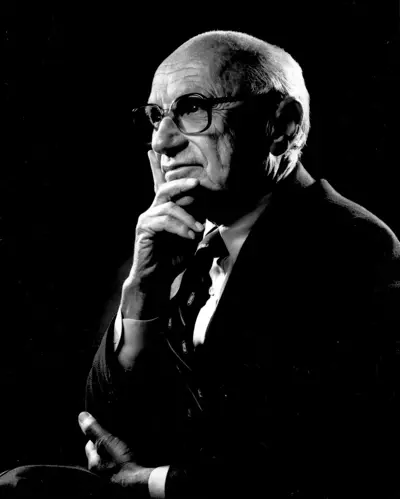
Milton Friedman was an American economist and statistician who received the 1976 Nobel Memorial Prize in Economic Sciences for his research on consumption analysis, monetary history and theory and the complexity of stabilization policy. With George Stigler and others, Friedman was among the intellectual leaders of the Chicago school of economics, a neoclassical school of economic thought associated with the work of the faculty at the University of Chicago that rejected Keynesianism in favor of monetarism until the mid-1970s, when it turned to new classical macroeconomics heavily based on the concept of rational expectations. Several students and young professors who were recruited or mentored by Friedman at Chicago went on to become leading economists, including Gary Becker, Robert Fogel, Thomas Sowell and Robert Lucas Jr.
