J. Edgar Hoover Quotes
…burrhead
The term refers to the short curly hair that many Backs have. Hoover was an inveterate racist. See {620620} for another example.
J. Edgar Hoover, 1895-1972, Director, Federal Bureau of Investigation, Derogatory Reference to Martin Luther King, Quoted in Nick Kotz, Judgment Days
Sourced by: Eigen's Political and Historical Quotations

This quotation provides us with several important insights in American history. First, the Director of the FBI was an inveterate racist. Second, he felt no inhibition on sharing this discriminatory view with the Media. Third, he is yet another source for the fact that Blacks did not have a decent opportunity to get an education. There were some Southerners who maintained that they did have such an opportunity in the “Separate but Equal” segregated schools systems of the South. Hoover was not the only racist in the upper ranks of the FBI; most of the leadership was prejudiced. See {620621} and {74219} .

When called upon to resign by members of the town council, he refused on the grounds that he had a right to freely express is views of President Obama or anyone else. There was no impeachment statute at the time in Wolfeboro and people were not happy about waiting for the next election. There was much pressure brought to bear including some who boycotted the town. He resigned 2 monnths later.


Describing the National Association for the Advancement of Colored People in speeches in the 1960's:

After attending a Lincoln speech, Booth said to Lewis Powell, one of his band of conspirators, “Now, by God, I’ll put him through. That is the last speech he will ever make.”


Forrest went on to be the first National Leader of the Terrorist Organzation.

Obama won. But this quotation illustrates one the many racist attacks made against America’s first Black President. Obama’s father had been born in Kenya, his mother and he in the United States.

The law enforcement officers were the ones who broke the law when they beat and brutalized the peaceful civil rights marchers. The “white niggers” refer to the white marchers including clergy.
Louis Napoleon Bonaparte. The “colonies” to which we was referring were the French Colonies in the Caribbean—particularly Haiti. The Black slaves had revolted against the slave-owners and had taken over all positions of authority and wore the uniforms and symbols of power including the epaulettes—the gold braid shoulder pieces that were symbols of high rank in military and diplomatic uniforms which were worn on all official occasions. Napoleon never did make good on his vow. He had many more problems with his own wars and governance in Europe. This quote does demonstrate the racism that existed in supposedly tolerant France.

He was a Senator from Pennsylvania when he made this remark.

Theodore Roosevelt, became President when President McKinley was assassinated. One thing that he did was to have the Negro leader, Booker T. Washington to lunch at the White House. He had previously had Blacks in his famous Rough Riders. Although Roosevelt had not taken a public position in inter-racial marriage, in the South, and much of rest of the country, accusing someone of favoring miscegenation was as serious an insult as there was. The accusation was used to attack anyone who did not favor segregation, lynching and Jim Crow in the same way that people who favored Medicare or Labor Unions were called “communists”. Cardamon himself was the target of many for his disrespectful and gross description of the president. See Quotation

Andrew Macdonald

Billy Sunday was the most famous preacher of the day. Unlike the vast majority of white preachers, he not only preached to black audiences but exuded an atmosphere of friendliness and comfort around Blacks that amazed most. Most Black leaders thought Sunday was very good for race relations, but there were some clergy like Grimke who criticized him. Sunday was castigated by many racist whites for preaching to Blacks, but he did not go as far as to condemn or preach against racism and the discrimination of the day and he would not preach to an integrated audience. Grimke, in contrast, preached to an integrated congregation and was one of the few white clergy who did in the South. (Washington DC was then a southern, segregated city.) See {585415} for another critique of Sunday.
This quotation was used by the Lyndon B. Johnson 1964 Campaign as: “We represent the majority of the people in Alabama who hate niggerism, Catholicism, Judaism, and all the isms of the whole world.” So said Robert Creel of the Alabama Ku Klux Klan. He also said, “I like Barry Goldwater. He needs our help.” The second statement was made at a different time.
The irony was that Breen was in charge of the Motion Picture censorship at a time when he personally could block any motion picture from being exhibited by withholding the Hollywood Production Seal of Approval. He was not only a virulent anti-Semitic but prohibited things like scenes with a double bed rather than twin beds for married couples.

American Communist Party Newspaper. The communists were so supportive of the war effort that they were often unconditional defenders of the Roosevelt Administration’s war program. Most communists suspended their advocacy of labor strikes and Black enfranchisement during the war because it would ultimately lead to the weakening of the Allied efforts against the Nazis. Programs such as the “March on Washington Movement” were seen as untimely and therefore subversive and fascist. For more communist criticism of attempts during this period to further civil rights see {603312}


First Lady Lou Henry Hoover, 1874-1944, invited Jessie DePriest the Black wife of a Congressman to tea at the White House. No Black woman had ever been there socially before. This was a typical Southern reaction. The Texas State legislature actually passed a resolution chastising the First Lady—the only such action in American history.


She was one of the first prominent white southerners to denounce racial segregation.
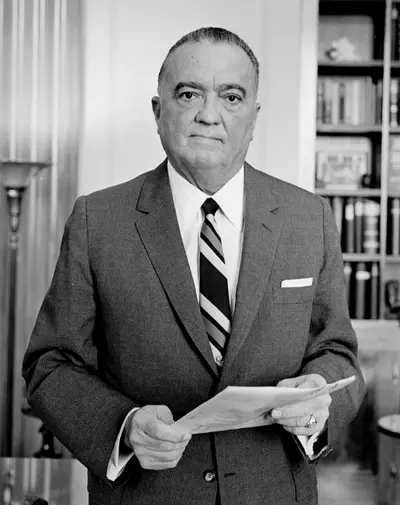
- Born: January 1, 1895
- Died: May 2, 1972
- Nationality: American
- Profession: Public Servant
John Edgar Hoover was an American law enforcement administrator who served as the first Director of the Federal Bureau of Investigation (FBI) of the United States. He was appointed director of the Bureau of Investigation – the FBI's predecessor – in 1924 and was instrumental in founding the FBI in 1935, where he remained director for another 37 years until his death in 1972 at the age of 77. Hoover has been credited with building the FBI into a larger crime-fighting agency than it was at its inception and with instituting a number of modernizations to police technology, such as a centralized fingerprint file and forensic laboratories. Hoover is also credited with establishing and expanding a national blacklist, referred to as the FBI Index or Index List, renamed in 2001 as the Terrorist Screening Database which the FBI still compiles and manages.
