Conan O'Brien Quotes
Big night of television tonight for Barack Obama. Earlier tonight, Barack Obama aired a half-hour infomercial to attract more voters. Yeah. Yeah, and apparently, if you watched the entire infomercial, Barack threw in a free set of Ginsu knives for you.
O'Brien, Conan. Late Night with Conan O'Brien. NBC, 2008.

Sinclair was a writer who had written about some of the worst scandals in American politics, leaned toward socialized democracy, and decided to run as a reform candidate in California where he lived. He won the Democratic primary easily even though he had no money, political experience, or backing. He terrified the Republicans who ran one of the dirtiest campaigns in American History to defeat him spending more money than in any election up to then including the Presidential elections. (for more details see {619613}) Sinclair lost, but it was close.

The ad, created by Tony Schwartz, only ran once, on September 7, 1964. It was so dramatic that News and other media replayed it and discussed it up until the election. LBJ’s opponent Barry Goldwater was a military hawk in the midst of the Cold war where nuclear war was everyone’s greatest fear. The Daisy ad was crystal clear and made overt what many Americans concern was about Goldwater. Johnson won in a landslide. See {586351} for the kinds of views that made Goldwater so vulnerable.

This is a fascinating quotation because it illustrates how political attitudes have changed since then. Stevenson meant this to be an insult to and even a charge against the men who ran the Eisenhower administration and campaign but not the President personally. And that was the way that it was taken. Republicans were insulted and thought this was a scurrilous charge by a candidate who was down in the polls but wanted to throw “red meat” to his base. However, when we read the statement today, it doesn’t seem at all like an insult. As a matter of fact, there are few politicians today, of either party, who would not agree with the views that Stevenson accuses the Republican strategists of having. Arguably, the Democrats were historically very slow to arrive at he place the Republicans had achieved. But in 1956 it was almost unethical to use shows and advertising techniques to manipulate public opinion. Politicians had been doing it since the beginning of our Republic but it used to be something a little dirty—something to which no one wanted to public admit believing. Today, politicians of both parties are often criticized by their base and the pundits for not believing sufficiently in the importance of image manipulation and advertising. Today, virtually no politicians have any moral scruples about using the techniques, doing so overtly and being proud of their staffs for being good at it.


It was, but each subsequent Presidential election grew much commercial, more sophisticated, and more expensive.

She was writing regarding the first use of television in a presidential campaign and the first time the public had ever been exposed to spot political ads. The practice, innovated in the Eisenhower campaign of 1952, was thought of as playing to the lowest element of the electorate’s psyche—selling politicians as if they were breakfast cereal or soap flakes. However, the technique worked incredibly well electing Eisenhower over Stephenson. Mannes wrote this after the election commenting on what politics had become.
Many studies have shown that most of us believe that commercial, political, and ideological advertising techniques are effective on most people but they do not feel that they are personally influenced much.
This is not always implemented by modern politicians who only see the young through the narrow lens of people too young to vote yet or for those that are of age, have poor turnout statistics. However, Quintus appreciated the other values of the young. President Barack Obama used this principle effectively and better than most modern candidates. Quintus’ older brother was running for Consul—the highest elected office of the Roman Empire. The Handbook, was his advice to his brother as to how to conduct his campaign.


Haldeman was then an advertising executive nat J. Walter Thompson


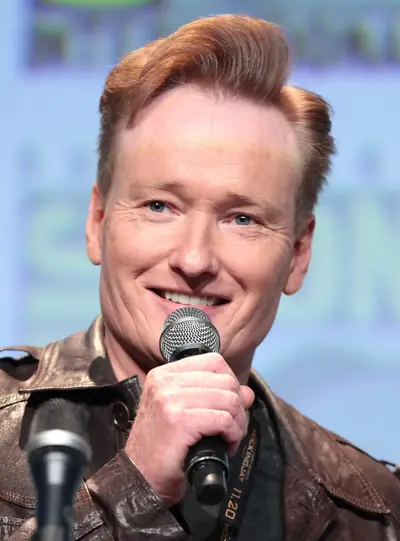
Conan Christopher O'Brien is an American television host, comedian, writer, and producer. He is best known for hosting several late-night talk shows; since 2010, he has hosted Conan on the cable channel TBS. O'Brien was born in Brookline, Massachusetts, and was raised in an Irish Catholic family. He served as president of The Harvard Lampoon while attending Harvard University, and was a writer for the sketch comedy series Not Necessarily the News.
