Conrad III Quotes
At the same time the Turks did not cease to attack and slaughter the crowd of foot-soldiers who were unable to follow the army. We pitied the fate of our suffering people, perishing by famine and by the arrows of the enemy; and by the advice of our princes and barons, we led the army back from that desert land to the sea, in order that it might regain its strength. We preferred to preserve the army for greater achievements rather than to win so bloody a victory over archers.
This is an early example of spinning. The Crusaders had been routed very badly. Conrad, attempting to report to the home front, describes the event as a strategic retreat.
Conrad III, c.1093–1152, King of Germany, Letter to Wibald, Abbot of Corvey, 1148
Sourced by: Eigen's Political and Historical Quotations

This is one of the best summaries of Lincoln’s early strategic thinking about the war. Unfortunately for him and the country, his generals were all trained in tactics rather than strategy. And the then modern world placed industry, logistics, and economics on a par with battlefield tactics. Until Generals Grant and Sherman were elevated to higher command, there were no military leaders who thought about the war in overall strategic terms. Lincoln, Grant, and Sherman in a sense created the first strategic approach to modern warfare.

Washington was describing the British strategy at the start of the war. The expectation was not only that of the British high command in America but was the prevailing expectation in the Court, Parliament, and the media in London. British critics of the military strategy point to this as a key reason the British lost the war in the end. Instead of waiting for the American troops to fall apart during the hard winter and gain a cheap and easy victory, the critics argue that the British should have initiated full scale attacks on the weakened and ill provisioned American soldiers.


After the Battle of the Wilderness, just before the Battle of Spotsylvania Courthouse, Grant wrote:

Unlike many socialists who were pacifists and against WWI, Foster and the communists were supporters of the war against fascist Germany, This was one of the reasons that Nazi Germany was virulently anti-communist later.


Some scholars look back at the allied bombing of German Cities in WWII with criticism that it was morally improper to bomb populated cities, and that the use of the adjective “exterminating” indicated that Churchill was more interested in killing Germans than strategic victory. This revisionist history has two failings. First, the Germans had already bombed Coventry, London and other civilian targets in England as well as cities in Holland, Poland and other countries killing many civilians. As a result, under the rules of war, Germany was no longer entitled to protection for their cities. Further, Hamburg and other targets were manufacturing sites of war material and as such lost the protection anyway. Even Dresden, which had very little war manufacturing was the main location for R&R of German Officers and by their military presence in the city converted it into a legitimate target. FDR agreed with Churchill, that the bombing was a good strategy to cause Hitler to fall as they thought the public would rebel. They were wrong however and his grip on the population through the Gestapo and the military was so strong that, it took a land invasion and occupation to put an end to Hitler. However, the devastating bombing all but crippled the German weapons development and deployment. For example. The Germans had developed the Jet Airplane Engine and actually put a few in the fight at the end if the war. Without the bombing, they would have had many more and countered the allied air supremacy. However, it is also true that Churchill and many Englishmen and some Americans believed that the English were morally entitled to retaliation for the innocent civilians killed with the German bombing of civilian targets.


Note that even then, De Gaulle’s nationalist ego focused not only on glory but glory that need not be shared. It was always a great strength and a great weakness for him. He and many French officers were so fixed on the glory of beating the Germans, that they did not focus on their ½ million casualties and were not prepared for the German countermeasures that turned the battle from a French victory to a long standoff and stalemate of the “Western Front” where neither side could advance much. Note also that De Gaulle failed to mention the British Expeditionary Force that twice saved the French from being overrun. Denial for the honor of France was always one of De Gaulle’s characteristics. See {642233} for the English commander’s view of the outcome of the Battle of the Marne.


This may have been the origin of the famous Stalin later quotation of very similar sentiment {616657}. No one is certain if Stalin had ever seen this work. Or he might have come upon it independently. The original source does not mention Massigli by name. However the description of the “Diplomat vom Quai d’Orsay” fits Massigli and his expertise so we attribute it to him. However, he was not the first to express this idea. The Anglican Bishop of London, Beilby Porteus, appears to have been the earliest—See {627489}.


Instead Lee took Longstreet’s advice and surrendered at Appomattox.

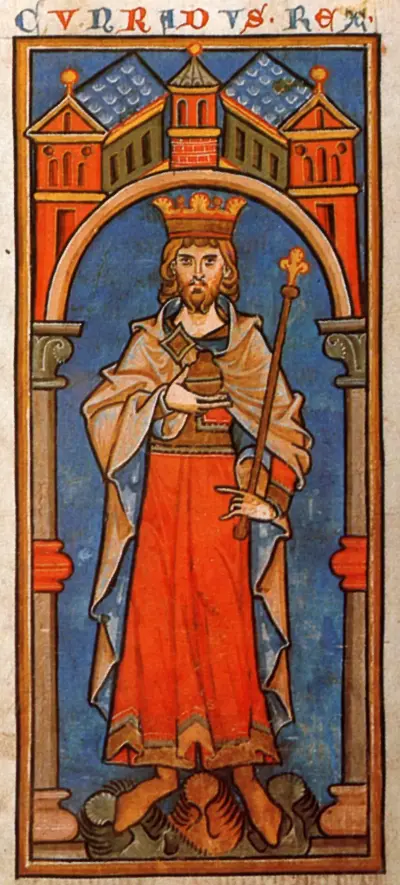
Conrad III of the Hohenstaufen dynasty was from 1116 to 1120 Duke of Franconia, from 1127 to 1135 anti-king of his predecessor King Lothair III and from 1138 until his death in 1152 King in the Holy Roman Empire. He was the son of Duke Frederick I of Swabia and Agnes, a daughter of the Salian Emperor Henry IV.
