Paul Farmer Quotes
Anywhere you have extreme poverty and no national health insurance, no promise of health care regardless of social standing, that's where you see the sharp limitations of market-based health care.
Farmer, Paul. To Repair the World: Paul Farmer Speaks to the Next Generation. University of California Press, 2013.


At the time in America, the insurance companies only paid out less than 80 percent of all the money they took in for health insurance. More than 20 percent went into their high overhead and profits. In contrast, to the 20 percent or more that it costs with insurance companies to administer health insurance payments, the agency that performs the same function for Medicare doe so with only a 6 percent cost Sanders argued that by getting rid of the insurance companies, the nation could save about 14 percent of the entire insured medical bills for the nation—many billions of dollars which would reduce average health insurance premiums by 14 percent. Opponents argue that the would be a socialist system and give too much potential control of individual health matters to a government operated or government controlled organizations. Politicians, in order to look good with the voters, would lower premiums and also pay out less either shortchanging doctors and hospitals or rating medial care somehow.


This was yet another call for national health insurance that begun by President Harry S Truman. Many Democratic efforts were unsuccessful until President Barack Obama finally passed a basic health care reform system fully 40 years after McGovern’s call.


Unlike most forms of insurance virtually everyone will have one or more claims and collect in his or her lifetime. Many of use will never have an automobile crash and collect on our insurance policy, but health is different in that we all change health status from well to ill at times and if we are fortunate we return to a state of wellness. But as Eigen observes, most of us who are tell are only temporarily well, With time our state will change to ill and if we are not very fortunate we will never use our health insurance as we will be dead. There is almost no way to age in a modern society without needing health care or funeral services, That is the consequence of the normal process of aging. So with health insurance schemes we, in effect, pass money from the living well to the living ill. So if health care costs increase fastr than inflation, which it has almost always done in the last half century, the temporarily well will be paying more and more. The only way to break that cycle is to somehow limit the cost increases of health care to that of the inflationary increase. Eigen has argued that most of us focus on the wrong problem--the details of the way the well pay for the ill, when the only soltuion is to reduce the rate of increases of health care costs. And there are only 2 ways to do that: Reduce the compensation for all the health care actors--physicians, nurses, other staff, hospitals, and manufacturers of medical equipment, supplies and expecially pharmaceuticals which have been increasing at the fastest rate of all or wer privide more and more effective prevention.

There were many countries whose laws proclaimed that health care was a right but could not deliver the health care to many of its citizens. However, every developed country except the United States considered health care a right and delivered health care to its people. The large majority of U. S. citizens received good health care but not as a right.


He, like so many Americans were shocked at the statistics on the relationship between earnings and infant mortality which does not exist in other industrial democracies.


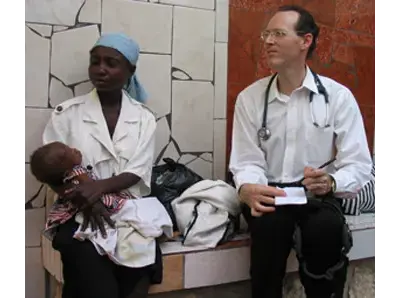
Paul Edward Farmer is an American medical anthropologist and physician. Farmer holds an MD and PhD from Harvard University, where he is the Kolokotrones University Professor and the chair of the Department of Global Health and Social Medicine at Harvard Medical School. He is co-founder and chief strategist of Partners In Health (PIH), an international non-profit organization that since 1987 has provided direct health care services and undertaken research and advocacy activities on behalf of those who are sick and living in poverty. He is professor of medicine and chief of the Division of Global Health Equity at Brigham and Women’s Hospital.
