George Galloway Quotes
Any President must depend upon congressional support in order to implement his foreign policy, for Congress has power to regulate foreign commerce, to raise armies and maintain navies, to lay and collect taxes for the common defense, and to declare war.
George Galloway, 1898-1967, Historian, Library of Congress, History of the House of Representatives
Sourced by: Eigen's Political and Historical Quotations


From this quotation, {624648} and {615902} it is clear that the framers of the Constitution intended the treaty making powers to be shared by the President and the Senate. In practice, in modern times treaties are usually initially negotiated by diplomats under the supervision of the President and the Senate gets to concur or not in the ratification process. However, there have been a number of treaty failures including the League of Nations where the lack of coordination has resulted in a situation where the Senate had to accept or reject something which the President had negotiated and the Senate rejected the treaty.

When the Senate was debating the Gulf of Tonkin Resolution, which would empower the President to take "all necessary measures" to repel any armed attack on U. S. forces, Senator Morse was one of only two Senators opposing the resolution:


Vidal, a staunch liberal held this view along with many ultra conservatives end extreme liberals. The constitution requires the Congress to declare war, but they have not done so for any of the wars since WWII. The President assumed the war power. And the only coherent budgets began.

This notion seems to have first been expressed by Edward S. Corwin in 1940


to send troops to Cuba The problem in Cuba was not even a crisis for America. But the precedent became the beginning of a huge change in the balance of power between the President and Congress. Together with his huge popularity, Roosevelt could do almost anything and have public support, but the war powers—the authority to send American troops into harm’s way—started their profound shift from requiring the President to ask Congress to declare war and the President acting unilaterally which had become common by the 21st century.


In 1949 the NATO treaty was signed. There was concern that a phrase in the treaty authorizing signatories to take "such action as it deems necessary, including the use of armed force" would undermine Congress's powers:

The Mexican War was as controversial as any war in American History. President Polk ordered action independent of the Congress, In all of American History there have been two Congressional censures of American Presidents. This was one. See {594521} for the other.


Alberto Gonzalez, White House Counsel and later Attorney General who was forced to resign and David S. Addington, Counsel to the Vice President, had come up with a novel view of the powers of the presidency. They argued that since the President is the Commander in Chief, in a war situation or intelligence gathering thereto, has the Constitutional responsibility for that function, he need not obey any laws of Congress as in the conduct of the war Congress would be impinging on the Constitutional separation of powers which itself was prohibited by the Constitution. The argument did not find any significant legal support but for a while the George W. Bush White House behaved as if this were the law, despite the fact that even in the American Revolution and the War of 1812 Congress passed laws regulating the conduct of the armed forces as is provided for in other parts of the Constitution. Yet even Goldsmith would allow the President some powers that many think are unconstitutional and/or belong to Congress. See {32436}.

President George W. Bush initiated an invasion of Iraq based on the fact that Iraq was developing nuclear, chemical and biological weapons. After the invasion however, there were none of these weapons found and much evidence that there were not any at that point in time. By the time Congress, the body which is supposed to declare war, found out that the reason for the war was bogus, it was too late. We had already occupied the country and were in the midst of a civil war. The President either acted on bad intelligence or wanted to invade Iraq for other reasons and history may finally tell us which, but Fein sees the problem as too much secrecy in the executive branch.


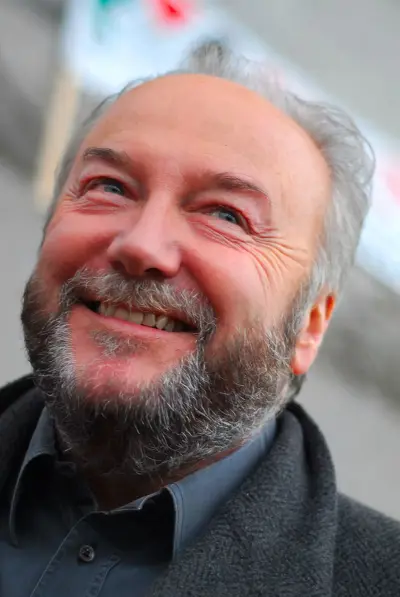
George Galloway is a British politician, broadcaster and writer. He currently presents The Mother of All Talk Shows on Radio Sputnik and Sputnik on RT UK. Between 1987 and 2015, except for a period between 2010 and 2012, he was a Member of Parliament (MP) for four constituencies, first for the Labour Party and later the Respect Party, the latter of which he founded in 2004 and led until its dissolution in 2016. He is currently the leader of the Workers Party of Britain, which he founded in 2019 in response to the defeat of Jeremy Corbyn in the 2019 General Election, and the Lead Spokesman for All for Unity, a Scottish-based party he founded to support British unionism in the face of rising support for Scottish independence and the Scottish National Party (SNP).
