Muhammad Quotes
And concerning their saying, 'We killed the Messiah Jesus son of Mary, Allah's Messenger.' They killed him not, nor crucified, but it appeared so to them. Indeed those who disagree concerning it are in doubt about it. They have no (true) knowledge about it except that they follow conjecture. Surely, they did not kill him. But Allah did take him up unto Himself. Allah is ever Mighty, Wise.
This Koranic passage represents the Muslim belief regarding the Crucifixion. The deny that Christ was crucified or even killed in any manner. But they do believe that God raised him to Heaven as God sent his agents to save him from the pain and suffering. Those who thought that he was crucified were just repeating the error of some people who were confused as to who was crucified and who was not. In the dark and middle ages, many Christians were infuriated with the denial of the Crucifixion of Jesus and saw that as not only blasphemous but deserving of death to such a false believer. In more modern times, some Christians find the viewpoint insulting but there is more tolerance of views which Christian theologians simply regard as “error.” In the early history of Christianity there were some Christians who felt that God had enabled Jesus to escape crucifixion. It took some time for the Crucifixion to become settled Christian doctrine. Some Christians feel that those who denied the crucifixion could not have been Christians but there were a few people who believed in the rest of Christian doctrine except that Christ was crucified, believing as the later Muslims did that God raised him directly to heaven.
Muhammad, 571-632, Prophet and Founder of Islam, Koran, :An-Nisaa’ 157-158
Sourced by: Eigen's Political and Historical Quotations


While most American leaders in 1776 advocated separation of church and state, others did not. There probably has been no better statement for religion in government than this one. Essentially, this view has been held by orthodox Christians, Jews, Muslims and has been at the heart of every theocracy such as Iran.


Samuel Langhorne Clemens, 1835-1910

There is a striking similarity of speech between Menelik and the monarchs of Europe with respect to his Divine right of rule and dependence on God. Ethiopia, in contrast to the rest of Africa, was a Christian kingdom and had been so for centuries. Menelik mobilized his people and produced a humiliating defeat for the Italians at Adowa in 1896 who never forgot and returned to conquer Ethiopia in the early part of World War II.


This proposal and others like it over the years have never even gotten out of Committee.


This for many suicide bombers provides much of the motivation and overcomes the prospect of suicide. According to Islamic doctrine, those killed in “the cause of Allah” go immediately to Paradise, unlike those who die a natural death. And when in Paradise, the males get 72 beautiful virgins.
For many extremists Muslims, this sura calls for the torture or killing of the enemies of Islam. For the more moderate Muslims, the penalty of opposing Islam should be expulsion or banishment. The further modern complication of this sura is the definition of “making war with Allah.” To some extremists, it is writing or publishing anything contrary to their view of Islam; it is occupying any Islamic nation or warring with that nation even though the basis of the war might have nothing to do with religion; it is bringing a Bible into an Islamic nations; it is allowing alcohol to be sold and served; it is opposing their discriminatory customs and laws; it is pressuring them not to stone adulteresses.
The Islamic Holy Book even recommends against friendships with Christians and Jews. See {584381}.
This sura is interpreted by some Islamic fundamentalists as absolution for the killing of a non-Muslim by a Muslim. It was Allah who did it. In a greater sense, critics of Islam observe that many Muslims and Islamic nations have a double standard of responsibility for crimes. If the victims are Muslims, the normal standards of morality hold; but if a non-believer there can be no crime. Terrorism, torture, beheading, mass murder can all be done with a clean conscience if a Muslim takes this interpretation of this sura. Many Muslims however take an opposite point of view. These people do not have the concept of fatalism and lack of free will that others believe. There is a parallel to this problem in Judeo Christian countries although it is less common statistically. But the murder of physicians who perform abortions, and the Jewish radical fundamentalist who killed innocent Arabs at worship are examples of people who viewed themselves as instruments of God in their heinous activities.
Christian sentiments like this were common during The Crusades where God would cause Christianity to prevail. However, with the Reformation, the enlightenment, the industrial revolution, and modernity, most Christians became more tolerant of other religions and accepting of the fact that there are other religions, which while not valid, would co-exist with Christianity. Islam backward and left out of the forces that modernized Christian nations entered the 21st century with large numbers of Muslims who believe in the literal truth of this sura and its desirability and their personal duty to help make it happen.

The so-called Second Crusade

In modern times there has been much criticism of the Muslim fundamentalists and the claim of the religious leadership that those who die in Holy War (Jihad) will immediately go to heaven. The concern is that this encourages terrorism and aggressive war. Yet, here we have virtually the same kind of “reward” for violence as issued by the Christians. See {611697} for another such example.

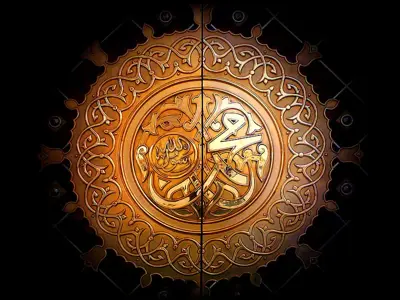
Muhammad was an Arab religious, social, and political leader and the founder of Islam. According to Islamic doctrine, he was a prophet, sent to preach and confirm the monotheistic teachings of Adam, Abraham, Moses, Jesus, and other prophets. He is believed to be the final prophet of God in all the main branches of Islam, though some modern denominations diverge from this belief. Muhammad united Arabia into a single Muslim polity, with the Quran as well as his teachings and practices forming the basis of Islamic religious belief.
