Montesquieu Quotes
An empire founded by arms, must likewise have arms for its support.
Charles de Montesquieu, 1689-1755, French Lawyer, Writer & Political Philosopher, Considerations sur les causes de la grandeur et des Romains et de leur decadence, xviii, 1734
Sourced by: Eigen's Political and Historical Quotations


During the presidential debates George W. Bush stated that he would be very hesitant to use the military for nation building around the world. Less than a year later, the Bush administration, faced with the September 11, 2001 terrorist attacks, launched a massive attack on the Taliban regime in Afghanistan. After fighting and winning the war, the military soon realized that they would in fact be involved in nation building. However, with the assistance of the United Nations much of the humanitarian burden was lifted from the U.S. military.


Napoleon was finally stopped by a multinational coalition led by England.

Congress and most of the Founding Fathers were very distrustful of standing armies. They were aware that standing armies had taken over societies ever since ancient Rome and Julius Caesar.

That was an ironic statement. Shortly thereafter we invaded Mexico, occupied the country, pressured it into “selling us much of what is now the Southwest of the United States, and finally left.


Pippin had the opportunity of expanding his empire by conquering the Lombards whose cavalry he could use if and when the Saracen Muslims would invade again. But he would be seizing another Christian country, contrary to the Pope’s edicts, thus losing the blessings of the Pope. Hence the question. He decided to go for the cavalry. Later, Joseph Stalin asked the same question in much different context. See {627524}. Some historians question whether Pippen actually uttered the quotation or just considered it.

Mao and other Chinese leaders molded the people into an Army to fight the invading Japanese in WWII after which they were attacked by Chiang Kai-shek’s Nationalists. In a remarkable trek of escape the Communists moved across China to escape the nationalists while the Red Army provided protection. Without the Red Army, the Communists would easily have been overrun then and after the Nationalists “escaped” to Taiwan they planned and threatened to invade the mainland. It was the Red Army that kept them at bay, and so the “People’s Army” has an emotional, historical and intellectual impact and role even in 21st Century China when there really are no enemies that would attack China.

“There” referred to the new American Colonies. He was advocating mobilizing the poor and destitute of England and sending them to America to provide manpower for a needed workforce and to be soldiers in the event of wars. The poor have historically been used indiscriminately for military manpower needs until Post WWII America where the military technology began to require minimum standards of intelligence and literacy. With the all volunteer military and higher standards, the majority of the military in America has been from the lower socioeconomic classes.

After the breakup of the Soviet Union, NATO expanded to include some fo the former Soviet Nations thus moving NATO territiry to the East--closer to Russia, whose leaders percieved that the expansion was hostile and dangerous for the indpendence of Russia. What made the situation more complex is that the American Secretary of State, when the Soviet Union was very powerful, had made an agreement with the Soviets that in return for Russian aquiessance of NATO being extended to East Germany, NATO would not expand further West. But after the collapse of the Soviet Union, Russia was quite weak and NATO expanded east despite the earleir comittment. The US and th eother NATO counties took the pozition the previous comitmnts were not binidng as they were never formally signed. The Russians then decided to take a hard line position and flaunt and use military force to which would stop the Western expansion closer to the Russian border.


This was written when the United States was not a dominant military power. At the beginning of the 20th century, the U. S. had the same size military as Argentina. It was France, German, Turkey and England who had the military superiority and it was they who tended to find excuses for war. After WWII, the U. S. was dominant and was involved with a number of wars and military incursions, often with nations that had not attacked the U.S. Korns’ principle was most dramatic when the George W. Bush administration invaded Iraq on the excuse that the Iraqis were developing weapons of mass destructions and then might attack the United States. After the successful invasion, the excuse was shown to be hollow as there were no signs of sophisticated weapons development.

He wrote this essay anonymously and signed it as “A Lover Of Peace”
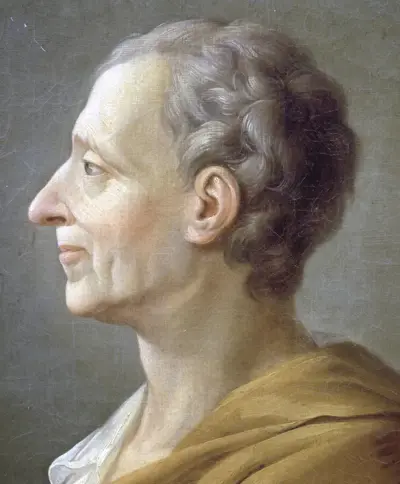
Charles-Louis de Secondat, Baron de La Brède et de Montesquieu, generally referred to as simply Montesquieu, was a French judge, man of letters, and political philosopher.
