Eric Holder Quotes
Although the attorney general is a part of the president's team, you're really separate and apart. You have a special responsibility as the nation's chief law enforcement officer. There has to be a distance that you keep - between this department and the White House.
Holder, Eric. Interview. NPR, 2014.


The Senate was investigating a scandal where the George W. Bush White House had induced the Attorney General, Alberto Gonzalez, to fire 8 of their own political U. S. Attorney appointments because they had or were investigating/prosecuting Republican politicians for corruption or not prosecuting Democrats vigorously enough. Gonzalez took the responsibility for the firings but did “not remember” why each had been fired nor was there any record in the Justice Department indicating any shortcoming with their jobs. The White House political operatives refused to testify under oath citing “Executive Privilege.”


Barstow the Democratic Governor who had no serious opposition in 1853 found himself challenged for reelection by Coles Bashford of the new Republican Party. The Board of Canvassers reported that Governor Barstow had won reelection but by less than 200 votes in the whole state. The Republicans charged that there had been fraud in some of the rural districts and petitioned the Wisconsin Supreme Court which ruled that nonexistent precincts had indeed voted for the Governor. The Barstow however refused to recognize the decisions of the court claiming that the court had no jurisdiction over the Board of Canvassers who were part of the executive branch. The Republicans held their own inauguration and two men claimed to be Governor. But the Governor claimed that the state constitution did not give the court any authority to deal with the crisis, He even called out the State Militia to maintain his office and intimidate the Supreme Court and keep the “other governor” from the state house. Nonetheless the court ruled that even the Governor had to obey the law and the Supreme Court would determine what the law was. Barstow finally “resigned.” See {587917} & {587914}.


His role was the equivalent of the Mayor of Washington DC. Even though the Congress had generally been the most powerful branch of the government, public opinion on this was beginning to shift at the turn of the 20th century.


The Supreme Court had decided to hear an important case on gun rights. Cheney discovered that Solicitor General, the Administration’s chief lawyer before the Supreme Court, Paul Clement planned to file a brief that was very different from Cheney’s own personal views. In protest, he signed his name to a much stronger brief filed by 55 pro-gun senators and 250 members of the House of Representatives. The President’s Chief of Staff called Cheney on the carpet for doing something that was unforgivable—the Vice President had publicly criticized the position that the President’s (and the Vice President’s) chief lawyer was taking. This was Cheney’s excuse—ie that he was not protesting as the Vice President but as President of the Senate, the only other Constitutional Role of the Vice President. Bolton let the vice president know that if he ever tried something like this again, he would be frozen out of most government activities. See {633772} . In Bush’s second term Cheney had less and less influence, in part because of his unethical behavior like this.

Senators have throughout our history used their power of treaty ratification to encroach on the executive branch and participate in the actual negotiations of treaties. President’s like McKinley to avoid non ratification actually appointed 3 senators to his 5 man treaty negotiating team. The 2/3 super majority is a high hurdle for ratification and presidents have always tilted with the Senate on treaties.


Periodically in American history, there has been a struggle between the Executive Branch and the Senate for dominance. The Senate’s power is negative however. It can block things, but cannot directly make them happen. The President can do both.


He was explaining his reasons for resigning in 2005 from the number two position in the Justice Department. The George W. Bush administration had implemented a program of secret wiretapping and surveillance of American citizens in America which required the authorization of the Justice Department which had determined that the program as it was being implemented violated the law. The Attorney General was ill in the hospital but had told Comey that he would not sign the authorization. The White House then pressured Comey to sign and he refused, and in a similar replay of the Watergate “Saturday Night Massacre”, the number three man at Justice would have been ordered to sign. His resignation convinced President Bush to alter the program to take account of the Justice Department objections.
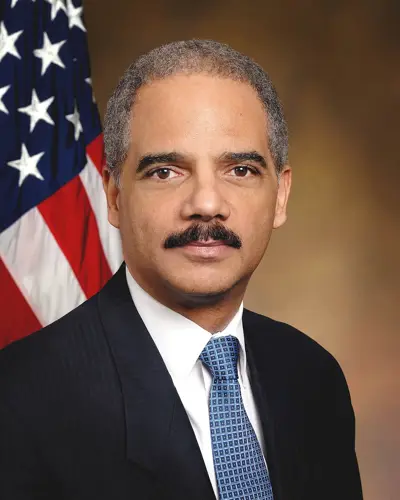
Eric Himpton Holder, Jr. served as the 82nd Attorney General of the United States, from 2009 to 2015. Holder, serving in the administration of President Barack Obama, was the first African American to hold the position of U.S. Attorney General.
