James Baird Weaver Quotes
After the Republican party got into power it turned around and granted the public domain to corporations and opened it to private speculators .... in violation of the principle announced in the platform of 1852. The land grants were a mistake, to draw it mildly and we may as well all admit it now ; it was a great wrong to grant a single acre of the public domain to corporations.... Every acre of the public lands should have been held for homes for the people, under a well-guarded homestead law. That was the proper way to deal with the public domain; but instead of that it was thrown open to ruthless speculators, who have speculated in it until the poor people of this country to-day have to fight for standing room
The Republicans had won with Abraham Lincoln in 1860.
James Baird Weaver, 1833–1912, U. S. Congressman (Greenback Party, IA), Twice Presidential Candidate (Greenback Party and then The People’s Party (Populists), ~1888
Sourced by: Eigen's Political and Historical Quotations


Wealthy men had purchased cheap land and moved into the area establishing large ranches and farms. The then very wealthy “newcomers” tended to do dominate the local politics and had much influence on national politics. They would employ the locals, but at very low wages.

Weaver thought that the huge Federal land holdings should only be used to give land to homeless people. With land, they could build shelter, plant food, and raise cattle. In modern times it is much more difficult to help the homeless for few people could survive on a parcel of land even if given.

Withdrawal meant not allowing certain public land to be sold or allotted to homesteading, commercial development, mining, industrial, ranching, or agricultural use. It was reserved as wilderness areas and/or national parks or forests.

This quotation electrified the crowd as few speeches at Democratic conventions ever had. The speech turned Cuomo into a national political figure and made him the front runner for the Democratic Presidential Nomination for the next 8 years. But he never chose to run despite overwhelming support and polls indicating he would be victorious in a general presidential election.


Corporate and business taxes were anathema to Republicans in 1899 as they were a century later. Roosevelt shocked the Republican base with statements like this, and when he implemented them, he became the most popular politician in America—possibly even more so than George Washington.

The issue was still not decided by the beginning of the 21st Century except that a certain amount of public disclosure was required if the company raised funds by selling stock to the public, but there were some giant corporations that were private and exercised huge power and influence and yet whose operations were secret.


Constantine the Great. Roman Emperors saw Christians as their most dangerous foes. However, Constantine, with this edict, enabled Christianity to thrive and grow legally in the Western world. Later Constantine himself converted to Christianity. This edict ceased the vicious Roman persecution that Christians had endured.


The major issue was whether Congress and the Federal Government could make laws and regulate the communities of people who had settled in the new territories. The argument that Young made was that unless a power was specifically enumerated in the Constitution as being granted to the Federal Government it was not. Most Constitutional scholars believe that there were powers implied by the enumerated powers such as the right for the Federal Government to regulate child labor or the safety of nuclear power plants which of course were never mentioned in the Constitution. At the same time anti Mormon sentiment led many to extend Federal Regulation to Mormons that had not been extended to other people/ Plural marriage was one of those major value issues. The Mormons were very innovative in setting up institutions like buying cooperatives and systems for medical care and welfare, and many of these threatened the then established economic principles of many men of power and wealth. See {614870} for John Taylor’s similar view.
Nelson was referring to the past. The industrial revolution created other forms of wealth and power as a huge factory could be built on a small piece of land. In farming, the yield is proportional to the acreage tilled. Not so in manufacturing. With the knowledge era, intellectual property could produce much wealth and power, and factory size and land ownership was not necessary.


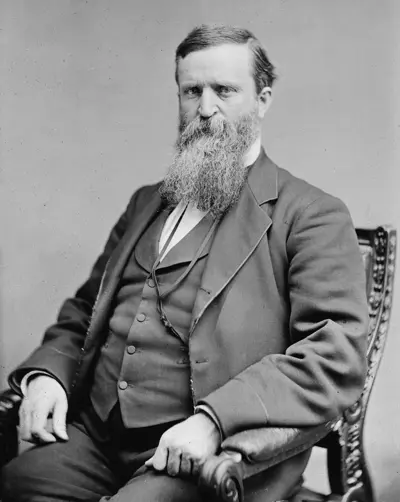
James Baird Weaver was a member of the United States House of Representatives and two-time candidate for President of the United States. Born in Ohio, he moved to Iowa as a boy when his family claimed a homestead on the frontier. He became politically active as a young man and was an advocate for farmers and laborers. He joined and quit several political parties in the furtherance of the progressive causes in which he believed. After serving in the Union Army in the American Civil War, Weaver returned to Iowa and worked for the election of Republican candidates. After several unsuccessful attempts at Republican nominations to various offices, and growing dissatisfied with the conservative wing of the party, in 1877 Weaver switched to the Greenback Party, which supported increasing the money supply and regulating big business. As a Greenbacker with Democratic support, Weaver won election to the House in 1878.
