John D. Long Quotes
According to the Superintendent of the Naval Records Office, of the 118,044 naval enlistments during the Civil War, 29,511 or about one-quarter were Negroes.
The U. S. Navy had Black sailors even before the Civil War. Blacks had shipped out on Northern merchant vessels and whaling ships starting in colonial times. Many Blacks had nautical experience and were welcomed by the Northern Navy and treated very well. The Union Army in contrast was much more ambivalent about Blacks serving. Ironically the Navy was disbanded to save money and when it was reconstituted it was on a racially segregated basis completely foreign to American Naval history. It was the last of the American armed services to integrate and its officer corps has not desecrated as much as the other services.
John D. Long, 1939-1915, Secretary of the Navy (Republican), Governor of Massachusetts, U. S. Congressman (Republican, MA), Letter, April 2, 1902
Sourced by: Eigen's Political and Historical Quotations


Knight led a band of whites and blacks who fought off the Confederate Troops sent to Jones County of Missisippi, to eleminate the Free State of Jones which tehy had set up, and seceded from the Confederacy. They had infuriated teh Confederate Government becasue it was an interracial community with a great deal of intermarriage and no discrimination agaisnt Blacks and they welcomed runaway slaves and white deserters from the Confederate Army.
loyalty oath to the King of England His “Ethiopian Regiment” was the first Black military regiment in North America. Soon after, Rhode Island organized a Black military unit—see {613949}.

Benjamin was the Confederacy’s strongest proponent for use of Negro troops in exchange for a promise of freedom. Ironically, the racial prejudice of the Southern soldier may well have doomed the South’s last chance for independence. Lee, although he personally favored such a course of action, could not get a general sentiment from the army as a whole.

This Civil War recruiting poster was described by the Free Library of Philadelphia as “Civil War recruitment print targeting African Americans by evoking the freedoms granted by the Emancipation Proclamation. Depicts a montage of symbolic scenes centered around an African American Union soldier triumphantly holding up a sword and an American flag with the banner "Freedom to the Slave." He stands near broken shackles upon a tri-color flag adorned with a coiled snake. The flag is tugged upon by one of three joyous slaves freed by an African American soldier. Other scenes depict an African American man reading a newspaper on a rocking chair near a plow and child, African American children entering a "Public School" near a church, and a regiment of "U.S. Colored Troops" marching across a battlefield strewn with dead bodies.”


Captain W.W. Polk, commanding the Coast Guard revenue cutter Florida, wrote Treasury Secretary asking permission to employ a young Negro on board. Existing regulations prohibited such. The Negro in question was a free Black born in New York who was an “expert sailor for his age and competent to the duty of a boy of the first class.” Polk had hired the boy as a servant after he had worked at sea for another Captain. Good seamen were hard to come by, decision was extremely contentious. Ingham “compromised” by limiting the allowable role of Negroes at sea—a practice that lasted till the Second World War.

The editor at the time was Dr. William H. Boyle but no one is sure whether he, the owner, or someone else, wrote the editorial. The quotation illustrated a fascinating twist of logic that was very commonly held at the time. “If God created men of different colors, he must have meant them to be separate.” It is fascinating that virtually no one at the time made a similar argument about hair or eye color, intellect or other differential traits of people. Although this logical fallacy waned in the latter part of the 20th century, there are some who still hold to it.

Phelps was a Copperhead Democrat who was a virulent racist, an enemy of Lincoln and supported McClellan against Lincoln in 1864. His extreme disrespect for the President and his racism was not appreciated in Vermont, and Phelps not only failed to help McClellan but destroyed his own credibility in his home state of Vermont. Phelps had been practicing law in New York City where there was a large Copperhead, racist and anti-Lincoln part of the population there.

When the Confederate Government realized that the Union was planning to arm escaped slaves and induct them into the Union Army, they quickly passed a law that declared any escaped slave who joined the Union Army or wore its uniform was guilty of Treason and would be executed. Most Union Generals one way or another got word to the Confederate Officers that they had better treat all Negro Union Soldiers as prisoners of war. Even President Lincoln warned the South. Butler, however, had a large number of Negro troops in his area and had heard threats of some of the Southerners to execute Black prisoners of war. He had a way of making things very clear, and he was able to prevent murder of any of his Negro troops despite the Treason law.

Although escaped slaves could not fight for the North, they could be very useful on road building and other military engineering projects needing labor. Every time a slave escaped, it diminished the military engineering labor of the Confederates by one but added to that of the Union. Pinkerton and others however engaged many escaped slaves who volunteered for an incredibly dangerous mission. They returned back to the Southern lines into the slave work gangs, and organized slave escapes of groups of Blacks. In addition, many of them, by observing and overhearing the Confederate soldiers gained information regarding supply and troop levels and movements, and this they brought back to the Union officers. Those that were caught were executed as spies. Escaped slaves were espionage and covert operations agents before they were allowed to be soldiers.

This part of Taft’s Inaugural Address shocked the South and much of the North. But these were the days when the Republican Party was the liberal party on racial issues and the Democratic Party housed most racists and bigots. On this, the parties would flip flop after the Democrats passed the Civil Rights and Voting Rights Bill. Both Taft and TR were racial liberals and the South coalesced around Woodrow Wilson, an intellectual but an inveterate racist.

Much of the South was so insular that people knew nothing about the notion of abolition and just assumed that no one would ever consider freeing the slaves. Many never knew that it was the South that first fired on the Union troops and flag. If the North won the war, the assumption was that Northerners would then own the plantations and the valuable slaves. In reality, while all slaves were emancipated in the South, very few plantations and farms were confiscated from their Southern owners by Northerners despite the fact that there was political pressure in the North to confiscate the land of all rebels who had committed treason and use the value to repay the Union bonds and care for the wounded Union veterans and the widows of dead Union Soldiers. Eggleston was an accomplished writer who had served in the Confederate army of the Civil War. 20 year after the war he wrote a series of articles for the prestigious Northern Atlantic Monthly trying to convey the war from the Southerner’s point of view.

He was a deeply religious Christian which is one of the reasons that he was appointed to head the Freemen’s Bureau to integrate the emancipated slaves into society. Howard University was named for him, and he served as its First President. For more about the Bureau. See {629185}.and {629187}.

After attending a Lincoln speech, Booth said to Lewis Powell, one of his band of conspirators, “Now, by God, I’ll put him through. That is the last speech he will ever make.”

The Planter had only two guns of its own, but was carrying a cargo of guns and ammunition that was to be delivered to the Confederate forts along the South Carolina coast. Smalls was then hired by the Union Navy as a Pilot and he engaged in a number of battles where he performed so well that he was transferred to the army which ran its own warships and made a Captain of the Vessel and achieved the rank of General although his duties were always at sea.


Despite the critical need of the war, racism was so extensive in the WWII military that Blacks were relegated to menial duty of cooking, truck driving and construction but were actually not allowed to fight at the beginning despite the fact that many had volunteered. Many whites—especially the southerners—were convinced that Negroes could not fight, that they lacked the courage and commitment. The need for troops in the Pacific theater was so great that in the invasion of Saipan that was so difficult, Black troops were committed to the fight and performed brilliantly. The Commandant of the Marine Corps, General Vandergrift was not only the first Marine 4 star general who was on active duty, but he personally was a recipient of the Medal of Honor. When he spoke, all marines and many others in the service listened. This was the break-though. Negroes in combat was no longer some kind of social experiment for most Marines except the most vitriolic rascists.


The officers were all white, and Higginson was the Commander. It was his first experience with Negro troops, and he had heard much extrapolation from racist attitudes about Blacks not being able to make good soldiers. Ironically, the same suspicions of Blacks as military men carried over into the Second World War when this canard was disproved so publicly that it finally was erased with the exception of the most inveterate racists for whom no evidence would matter.
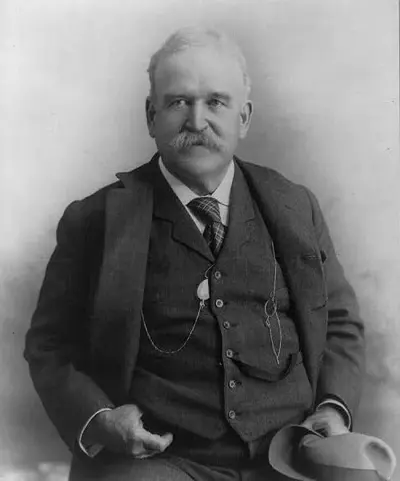
John Davis Long was an American lawyer, politician, and writer from Massachusetts. He was the 32nd Governor of Massachusetts, serving from 1880 to 1883. He later served as the Secretary of the Navy from 1897 to 1902, a period that included the primarily naval Spanish–American War.
