Henry David Thoreau Quotes
A government in which the majority rule in all cases cannot be based on justice, even as far as men understand it.
Henry David Thoreau, 1817-1862, Writer, Civil Disobedience, 1849
Sourced by: Eigen's Political and Historical Quotations


Jefferson had just won a bitter, partisan election, and this was his attempt to reach out to the Federalist minority whose newspapers had been predicting that a Jefferson victory would bring a tyranny of the majority.


A delegation from Sinn Fein, headed by Arthur Griffith and Michael Collins, had negotiated a treaty of Irish Independence except that it did not cover Northern Ireland where the majority of the people wanted to stay a part of Britain. For 700 years, the Irish had fought for independence, and finally they got it for the vast majority of Ireland and the overwhelming majority of the Catholics of Ireland. The alternative to agreeing to the treaty was to continue the war between the IRA and the British Troops. At the time, the IRA was just about totally beaten and probably could not hold out another month. De Valera, a very shrewd politician, as the leader of Sinn Fein (and the IRA) would normally have headed the Irish Delegation. But he chose not to because he realized that they would never get independence for all 32 counties of Ireland as the British would not leave the Northern Ireland Protestants to their fates against their will. The best Ireland could get was Independence for all of Catholic majority Ireland. And he knew that public opinion would oppose giving up even one county becuse that was what the leaders had told the people for years. So De Valera let his two associates take the popular blame after he denounced the treaty with his famous quotation {639690}. Shortly after that, Michael Collins, the brilliant military Commander of the IRA who signed the treaty was assassinated. To many, it was as if De Valera had pulled the trigger. The treaty was ratified by a 7 vote margin by the Dail as there was no army left to fight, and the angry Irish electorate voted for De Valera as Ireland’s first President. The politician had won; the patriot had died. De Valera continued to speak out against the Dail Majority for the “immoral” act of ratifying the treaty


“Factions” was the word for political parties then.


This quotation is historically important because Davis clearly states the reason for the rebellion of the South. The anti-slave states were growing at a greater rate than the slave states and despite the greater voting power that a southerner had (a result of the 3/5 count of slaves for census purposes, and the Senate), the handwriting was on the wall and the majority of the United States was against the vicious institution of slavery and would make it unprofitable, impossible and/or illegal in the coming years. Southern slavery advocates saw this as a “tyranny of the majority” and therefore took up arms. In the early 20th century, apologists for the Southern rebellion tried to promote the idea that there were reasons other than slavery, but this quotation and the resolutions of the states who withdrew from the Union make it clear that the right to maintain slavery was the only significant issue. In that sense it was a States’ Rights issue, but the South was opposed to States’ Rights when it came to States refusing to return fugitive slaves when Federal Law required such under the Dred Scott Supreme Court Decision.


This quotation is a great demonstration of how much wiser and the better politician of all the crowned heads of Europe that Queen Victoria was. There were stirrings of freedom and desire for parliamentary government throughout Europe. Queen Victoria, even though and perhaps because she was a young woman, had a great feel for fairness and reasonableness and had read a great deal of history. There were some radical red socialists calling for complete radical revolution scaring European Royalty profoundly. They reacted very conservatively and with reaction, reverting to more tyrannical practices of the past urged in that path by very conservative, right wing advisors. Victoria also had little respect for some of the monarchs who had little interest in their people and much with their personal power and wealth. In the end, it was England which was the only nation which never had a serious radical socialist / communist threat, and that had much to do with Victoria’s political acumen and wisdom.
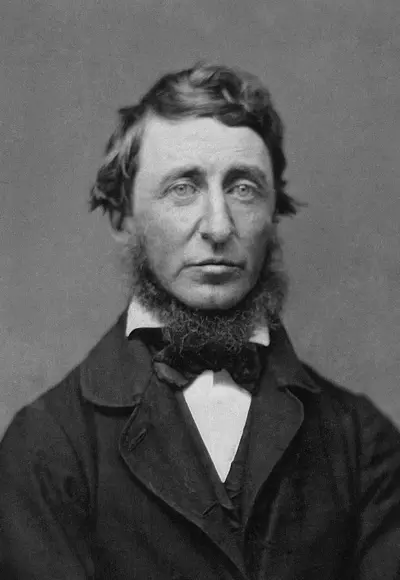
Henry David Thoreau was an American naturalist, essayist, poet, and philosopher. A leading transcendentalist, he is best known for his book Walden, a reflection upon simple living in natural surroundings, and his essay "Civil Disobedience" (originally published as "Resistance to Civil Government"), an argument for disobedience to an unjust state.
