Susan B. Anthony Quotes
You have trampled under foot every vital principle of our government. My natural rights, my civil rights, my political rights, my judicial rights, are all alike ignored. Robbed of the fundamental privilege of citizenship, I am degraded from the status of a citizen to that of a subject.
As a woman, Anthony was found guilty of “illegal voting” in the Presidential election of 1872. Fining her $100 the judge asked if she had anything to say. This was her reply.
Susan B. Anthony, 1820-1906, Woman's Suffrage Leader
Sourced by: Eigen's Political and Historical Quotations

He had been a Congressman before assuming the Presidency. Civil rights was a major subject of debate after the Civil War. One major issue was that of citizenship itself. Many contended that Americans were citizens of a state and dependant on the state for the protection of civil rights. However, the extent to which the Federal government could and should be the guarantor of citizenship issues was in dispute. Today with the issue settled in favor of Federal preeminence, it is hard to realize that this was very unsettled at one point in history. Garfield was one of those leading the effort for more Federal involvement and control.

Urging Black military participation for the Union in the Civil War:


This quotation was a slight paraphrase from Article 14 of the Republican Party Platform which had been adopted unanimously at the Chicago Party Convention on May 17, 1860. This was the convention where Lincoln was nominated. It is not known who originally drafted Article 14, although Lincoln's agents were very active in the platform drafting process. In his later campaign speech, Lincoln ran on the Party Platform.


It is ironic that Pakistan, the creation of Jinnah’s efforts, has to a great extent adopted Sharia (Islamic Law) resulting in severe curtailment of freedom of speech and thought. Professors languish in jail for not teaching the history of Muhammed in the orthodox way, people are sentenced to death for what the local mullahs regard as blasphemy—results which from Jinnah’s point of view were terrible.


The Grammar Curmudgeon. Almost every government action to protect rights impinges on the rights of some. For example, laws to protect minorities from discrimination in the workplace impinge on the right of employers to hire whomever they want. The Voting Rights Act eliminating the Poll Tax instituted to prevent Negroes from voting, impinged on the Southern States’ rights to determine the election rules and standards for their states. Laws requiring all pharmaceuticals to be approved by the Food and Drug Administration to protect the public from dangerous drugs interfere with the doctor’s and patient’s rights to determine the best treatment and the drug company’s right to sell whatever products they want.


This is a very important political, historical, and philosophical quotation. This is a view that is very common amongst many Americans—especially those who are religious. As a factual matter, it is not clear that ALL the founding fathers personally believed in the creator--God. All the views have never been discerned. However it is almost certain that the majority of the Founders so believed. The complication with taking this viewpoint too literally is that while our rights may have come from God, it is men who determined exactly what rights would be enumerated on our constitution. For example. the original draft of the Constitution did not include, the right to a free press, the right of due process, the right of being free from religious compulsion and others. Yet it passed. Then other men and women wanted more rights added and the Constitution was ratified on condition that the Bill or Rights would be incorporated as the first 10 amendments. There were other rights that were not explicitly mentioned. For example, there is no right to an education mentioned in the Constitution or any of the amendments. Blacks had no rights until additional amendments were passed. And later there was an amendment that denied Americans the right to drink alcohol. Then another that gave the rights back. There are rights that other nations have which we do not—ie the right to medical care. Which if these did God grant and which, not? So even if we assume that every one of the founding fathers not only believed in God, but believed the rights were all God given, we would still be in the practical dilemma of having to specify the language of each right and always to, by amendment, adding additional rights or modifying or even deleting older rights. Many believe that Americans were divinely inspired when we added (or changed) rights. Others, not. However, regardless, we must go through the same procedures of enumerating American rights and amending the constitution. So the process is the same for both those who believe that our rights come from God and those who do not. To change rights, we need the action of Americans divinely inspired or otherwise, but they can and have been changed. For example, before 1963 Americans did not have a right to use birth control devices. After the Supreme Court Griswald v. Conn. We did and now have a right to use birth control devices. The mode that rights are manifested, defined, enumerated and implemented is a political one—one that in our American system allows us all to implement that system whether or not we believe that our rights come from our Creator.


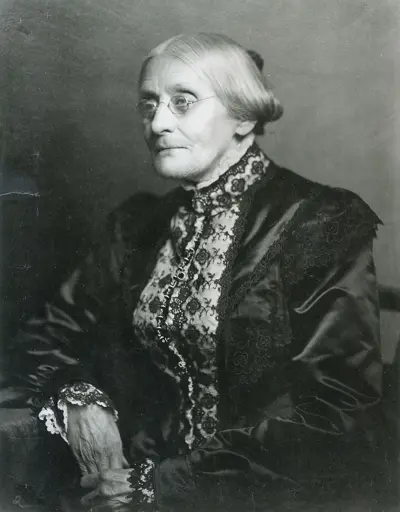
Susan B. Anthony was an American social reformer and women's rights activist who played a pivotal role in the women's suffrage movement. Born into a Quaker family committed to social equality, she collected anti-slavery petitions at the age of 17. In 1856, she became the New York state agent for the American Anti-Slavery Society.
