Karl Marx Quotes
Workers of the world unite; you have nothing to lose but your chains.


Comintern was upset by the American Socialist Party because the party had rejected the 21 Conditions for Affiliation and withdrew their intent to join the Third International. To Comintern, the Socialist Party was a party of “bourgeois socialism.”


Socialist International Anthem. Also adopted by the Communists


Despite his speeches like this one, he was a ruthless dictator who then before his death in 2000 handed power to his son.


This first meeting was held in a girls’ school. One of the delegates was a young library assistant and school teacher, Mau Tse Tung.


This was the basic document issued after the Russian Revolution establishing the basic legal and economic structure of the new Soviet State.


The slogan was made famous by James Larkin, 1875–1947, Irish trade union leader who used it frequently and whose memorial statue in Dublin contains the quotation in French, English and Irish.


The letter was widely published. There were few left wing intellectuals who would take Lenin on at the time but Gorter was one. The immediate quotation shredded a brochure that Lenin had produced for world wide communism where he was critical of other left wing movements.
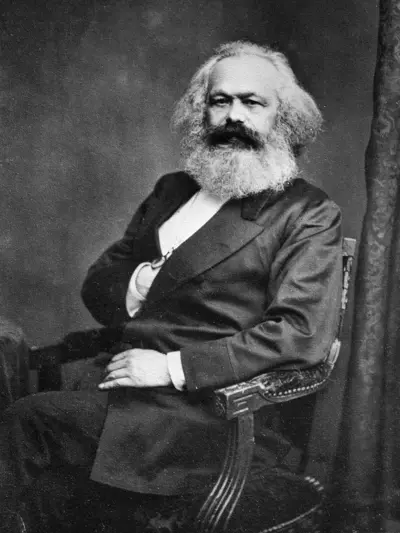
Karl Heinrich Marx was a German philosopher, economist, historian, sociologist, political theorist, journalist and socialist revolutionary. Born in Trier, Germany, Marx studied law and philosophy at university. He married Jenny von Westphalen in 1843. Due to his political publications, Marx became stateless and lived in exile with his wife and children in London for decades, where he continued to develop his thought in collaboration with German thinker Friedrich Engels and publish his writings, researching in the reading room of the British Museum. His best-known titles are the 1848 pamphlet The Communist Manifesto and the three-volume Das Kapital (1867–1883). Marx's political and philosophical thought had enormous influence on subsequent intellectual, economic and political history. His name has been used as an adjective, a noun, and a school of social theory.
