Donald Wuerl Quotes
When I was a young priest in the 1960s and 1970s, there was much experimentation and confusion in the Church. Teachers and clergy were encouraged to communicate an experience of God's love, but to do it without reference to the Creed, the sacraments, or the tradition.
Wuerl, Donald. Faith That Transforms Us: Reflections on the Creed. The Word Among Us Press, 2013.


This is a classic example of institutional reluctance to examine history in the light and morality of the present. Nations have difficulties coming to grips with their pasts just as Churches and other institutions do.


The struggle in the Catholic Church reached an amazing state. Just after a new pope, Martin V, had been elected the Council of Bishops at Constance came up with this notion which placed their views above those of the Pope under the theory that this particular council derived its power and authority directly from Christ while the pope was only God’s “vicar on earth.” The struggle was somewhat akin to the inevitable struggle for power between an executive branch and a legislative branch. The Council’s ascendancy didn’t last very long and was repudiated by successive popes.


This quotation is classic in that it illustrates a fundamental difference between a political and religious view of rights. Politically a citizen is entitled to rights with no requirement or condition of responsibility. Politically, we may desire and applaud or even reward responsible behavior, but we may not condition the rights on someone’s version of responsible use of the rights. Indeed, the real test is if people have rights who are generally thought to be irresponsible. See {633640} .


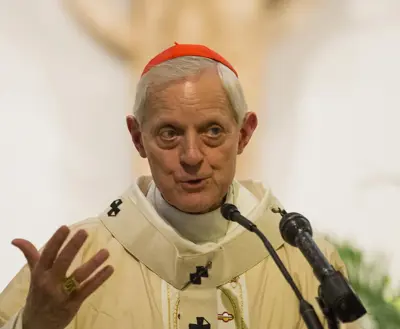
Donald William Wuerl is an American prelate, a Cardinal, of the Catholic Church. He served as Archbishop of Washington, D.C., from 2006 to 2018. He was elevated by Pope John Paul II to serve as Auxiliary Bishop of Seattle (1986–1987), and Bishop of Pittsburgh (1988–2006). He was named Archbishop of Washington by Pope Benedict XVI and made a cardinal by him in 2010.
