Anthony Kennedy Quotes
When a juvenile offender commits a heinous crime, the State can exact forfeiture of some of the most basic liberties, but the State cannot extinguish his life and his potential to attain a mature understanding of his own humanity.
Anthony Kennedy, Roper v. Simmons, 543 U.S. 551 (1 March 2005).
Sourced by: Eigen's Political and Historical Quotations


This quotation produced an angry reaction by extreme conservatives. Some anti-intellectual conservatives feel that there should never be any consideration given in American Jurisprudence to any ideas, laws, practices, or even scientific studies emanating from foreign counties. This was especially offensive to them because the reference to foreigners was made in a case that involved capital punishment. Execution of juveniles is one of the factors that has prevented the U.S. Senate from ratifying the United Nations Treaty on the Rights of the Child after it has been signed and then endorsed by administrations of both major political parties. America has been a pioneer of children’s rights, but the two sticking points are capital punishment and the right of a parent to apply corporal punishment at parental discretion which are banned by the Treaty.


Kennedy, who had supported the Juvenile death penalty in a 1989 case, but by 2005 he had changed his mind and the court by a narrow 5-4 vote abolished the juvenile death penalty.


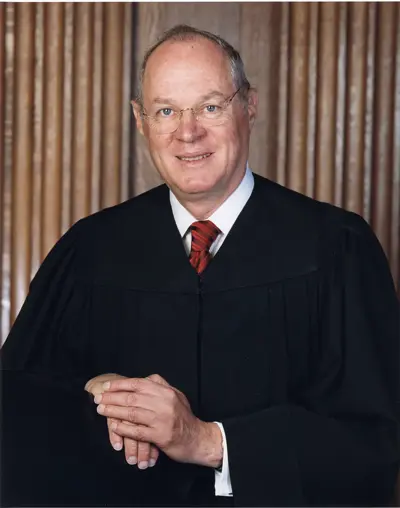
Anthony McLeod Kennedy is a retired American lawyer and jurist who served as an Associate Justice of the Supreme Court of the United States from 1988 until his retirement in 2018. He was nominated to the court in 1987 by President Ronald Reagan, and sworn in on February 18, 1988. After the retirement of Sandra Day O'Connor in 2006, he was the swing vote on many of the Roberts Court's 5–4 decisions.
