Karan Mahajan Quotes
When a certain swathe of India's population considers the country's ancient past, it doesn't see a country fragmented into kingdoms, savaged by caste divisions, and mired in poverty; rather, what's envisioned is a vast, unified Hindu empire stretching from Kashmir to the Indian tip at Kanyakumari.
Mahajan, Karan. "India's Vanishing History." The New York Times, The New York Times Company, 2018.


The Somnauth Temple was one of the holiest of Hindu shrines in India. It had been attacked, looted, and destroyed several times since its erection before the birth of Christ. A Northern Warlord Ruler had raided the temple and stolen the spectacular gates at the tomb. When the British Indian Army of Indians led by British officers and NCOs, conquered the Warlord area, Lord Ellenborough had the huge gates removed and returned to the Somnauth Temple issuing this proclamation which he arranged to have approved by Queen Victoria and have Parliament vote to return the gates. It was a brilliant historical instance of symbols having enormous political effect. Hindus throughout India, most of whom had forgotten about the stolen temple gates, had the British to thank for righting one of the great wrongs of Hindu history.


Although a Hindu, Nehru wrote of the atrophied Hindu society of India which enabled the Muslims to invade, conquer, and spread Islam over India.

This mode of national definition is characteristic of many nations of Europe as well.


The traditional Hindu social structure established castes – levels of society with Brahmins at the top and untouchables at the bottom. When India gained independence, the caste system was made illegal. Nonetheless, it is still followed by hundreds of millions of Indians. Religiously the Buddhists and the Hindus have had different philosophies. Ilaiah is a Buddhist who opposes the traditional Brahmin social structure and is a supporter of “Dalitization” – a change in the Indian culture to make the Dalits (untouchables) equal de juro and de facto.


Arguments against the Partition of India at the time centered around the poor economic viability of a separate Muslim state. However Iqbal and others placed the cultural issues in the forefront. They eventually prevailed.

His views are a mix of modernism and fundamentalism. He favors democracy and elections but also favored the Taliban destroying the great ancient Buddha statues when he was called an idol worshipper for urging the preservation of art.


Paz was the Ambassador to India. The caste system in India was outlawed by the Indian Constitution, and the government has made many effort at affirmative action to eliminate it put as Paz observed it is so ingrained in Indian tradition, culture and religion that it continues to persist.

Savarkar was a fascist-oriented, Hindu nationalist, who advocated a quasi Hindu theocracy and the relegation of Muslims to second class citizen status. See {641952}.


First non-Congress Party governor of an Indian State (Communist)


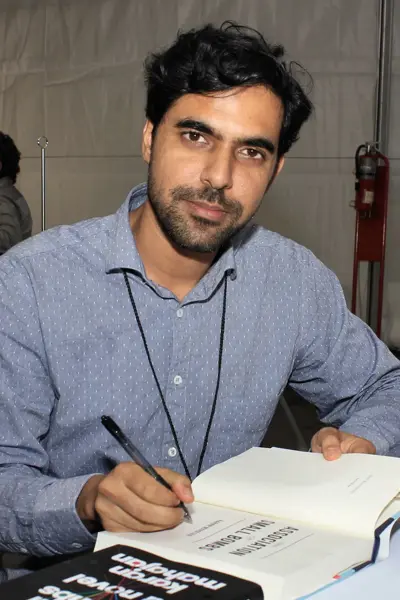
Karan Mahajan is an Indian-American novelist, essayist, and critic. His second novel, The Association of Small Bombs, was a finalist for the 2016 National Book Award for Fiction. He has contributed writing to The Believer, The Daily Beast, the San Francisco Chronicle, Granta, and The New Yorker. In 2017, he was named one of Granta's Best Young American Novelists.
