John Marshall Quotes
What do gentlemen mean by a strict construction? If they contend only against that enlarged construction which would extend words beyond their natural and obvious import, we might question the application of the term, but should not controvert the principle. If they contend for that narrow construction which, in support of some theory not to be found in the Constitution, would deny to the government those powers which the words of the grant, as usually understood, import, and which are consistent with the general views and objects of the instrument; for that narrow construction, which would cripple the government, and render it unequal to the objects for which it is declared to be instituted, and to which the powers given, as fairly understood, render it competent; then we cannot perceive the propriety of this strict construction, nor adopt it as the rule by which the Constitution is to be expounded. As men whose intentions require no concealment generally employ the words which most directly and aptly express the ideas they in tend to convey, the enlightened patriots who framed our Constitution, and the people who adopted it, must be understood to have employed words in their natural sense, and to have intended what they have said.
John Marshall, 1755-1835, Chief Justice of the U. S. Supreme Court, U. S. Congressman (Federalist, VA), U. S. Secretary of War, U. S. Secretary of State, Gibbons v. Ogden, 1824
Sourced by: Eigen's Political and Historical Quotations


This quotation is particularly important because it summarizes one of two opposite schools or thought regarding judicial interpretation of the Constitution that politicians have been arguing about since the Supreme Court first sat. The other is Original Intent where only the original intentions of the writers and ratifiers of the Constitution should be considered—assuming that it can be determined.


Cummings was arguing against a Constitutional amendment. His alternative led to Roosevelt's court packing schema.


He uses the term, “Non-interpretivism”, in a judge’s decision to indicate a judge who does not accept the interpretation of the Constitution as written and intended by the framers. His bias is a conservative one and this is how he views decisions that he does not like. When liberals see an opinion with which they do not agree, they also very often accuse the judge of activism and not adhering to the framer’s intentions. Generally it is a question of “whose ox is gored?”

The delegates to the 1787 Constitutional Convention were all men with different opinions. So the intent of the Framers might mean: The intent of the individual who proposed the section, the men who spoke on that section, the majority who voted to keep it in the document. This would be hard enough if there were a transcript of the debate, but there was not. We only have the notes of Madison and a few others at different times. And even they did not know the intentions on a given issue of delegates who did not speak. George Washington, for example, never spoke for or against any particular section of the Constitution. We can infer his intentions from other writings sometimes, but what about the delegates who did not write as much or whose letters and papers have not been found or preserved? The judges who must decide on constitutionality do the best that they can, and there is ALWAYS disagreement when judges make such a judgments and render an opinion.

From this quotation, {615902} and {615901} it is clear that the framers of the Constitution intended the treaty making powers to be shared by the President and the Senate. In practice, in modern times treaties are usually initially negotiated by diplomats under the supervision of the President and the Senate gets to concur or not in the ratification process. However, there have been a number of treaty failures including the League of Nations where the lack of coordination has resulted in a situation where the Senate had to accept or reject something which the President had negotiated and the Senate rejected the treaty.


The Chief Justice at the time was an ultra-conservative judge, who together with his 8 colleagues—all conservative—had blocked much of the democratic and progressive legislation that the Congress had passed. FDR had a much different legal and philosophical view of the Constitution than the Chief Justice, and the court would declare much of his New Deal legislation, passed in the emergency of the Great Depression, unconstitutional. Almost all of those “unconstitutional” things were years later passed again and this time a more modern court found they were Constitutional.


It is argued whether Scalia’s problem was that the Supreme Court was doing something new or radical or the country had changed. He had certainly lived through the greatest transformation of any society and culture on earth at a pace of change that far exceeds anything that has occurred before. Scalia is one who believes that the Constitution should not be interpreted in recognition of these changes, but should be immutable as it was written for the late 18th century. Most judges and legal scholars disagree and try to interpret the Constitution as the founders would have intended, knowing what we know, having the tools and powers we have, and facing the problems of the modern world. It represents a major legal and philosophical debate.


The argument was Prohibition, the 18th Amendment.

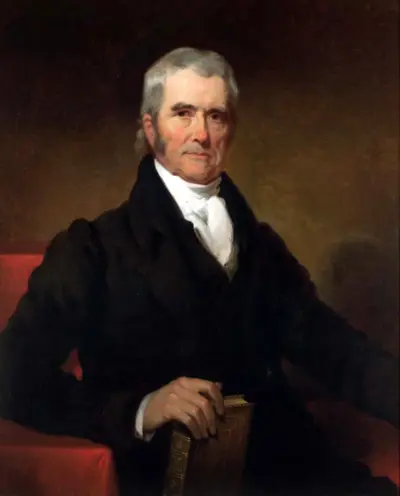
John Marshall was an American politician and lawyer who served as the fourth Chief Justice of the United States from 1801 to 1835. Marshall remains the longest-serving chief justice and fourth-longest serving justice in Supreme Court history, and he is widely regarded as one of the most influential justices to ever sit on the Supreme Court. Prior to joining the Supreme Court (and for one month simultaneous to his tenure as Chief Justice), Marshall served as the United States Secretary of State under President John Adams.
