Rush Limbaugh Quotes
We've discussed the public sector union people. We are messing with their bread and butter. They have their hands in the treasuries of all states in which they operate and the US Treasury. They have their hands there. That's how they live. Now, we're broke and the states are broke for a multitude of reasons. What they're being paid is among them.
Limbaugh, Rush. The Rush Limbaugh Show, Premiere Networks.

With the large number of jobs that are going overseas, and the increasing productivity, the economics of the late 20th century and early 21st century made job security an anachronism. Therefore the unions were weakened.


At the time, industrialists could not even conceive of the notion of negotiating over wages must less collective bargaining.
Van Cleave was rabidly opposed to any anti-trust government “interference” with business and he was also virulently opposed to labor unions. See {638616}, {638612}, {638614}, and {638613}.


At the time, most company owners and managers refused to bargain collectively with employee elected organizations. Hoover was then an exceptionally modern business person who realized the importance of good working relations between management and labor and advocated collective bargaining. However, as he got deeper into partisan politics, he backed off urging this. Nationally, in the 1960s collective bargaining had become an instrument of basic sound management, but more and more managements returned to simply refusing to bargain with employee organizations and instead strengthened their managers and supervisors and adopted (by choice and by government regulation) more and more modern, healthy, safe, efficient and attractive working conditions and policies. By the 21st century, labor unions and employee organizations had lost their attractiveness while managers were more attentive to workers and there were very few private companies engaged in collective bargaining.
This is a fascinating historical quotation about labor disputes and strikes. The conservatives at the beginning of the 20th century were horrified at the idea of a strike of any kind. Their idea of a labor dispute with picketing would allow one or two protesters with signs stating their case to stand outside the factory. Or one person visiting a worker and suggesting that the worker not work during the strike. However, when the degree of passion was expressed by many people picketing they were opposed. At the time, the working class and the unions had no other resources other than the bodies of their workers. They could not advertise, publish newspapers, hire lobbyists to explain their point of view to Parliament. The conservatives then were then very undemocratic and believed that the monarchy with a responsible aristocracy of the upper class should run the nation for all. They WERE actually intimidated by a large number of people doing anything that was not endorsed by or approved by the ruling class. Women in large protest marches for the right to vote were intimidating also. The threat was, as they saw it, “Do as we demand or we will bring down the world as you know it.” In a sense that is what happened. There is no conservative in England who would today deny a union the right to picket with many people.


The act gave unions rights of organization which they had not had before in America, but few critics ever characterized it in the over the top rhetoric which was characteristic of Nixon in his early political years.


Mencken had a genius for finding the weak and hypocritical aspects of all institutions and most people. As a result he is frequently quoted by one political side or another to attack something they want to diminish. His career is so prolific that it is usually easy to find something nasty he said about any group, idea or person. In this case, he also wrote scathingly against businessmen, corporations, capitalism and politicians favoring the wealthy.
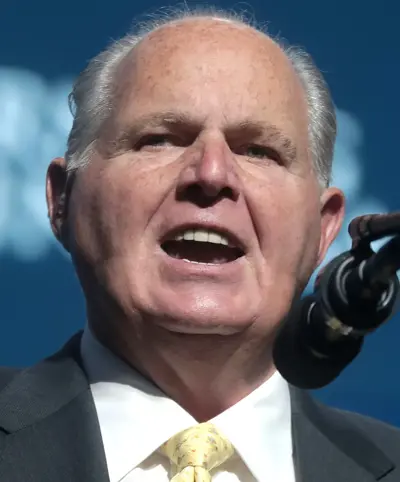
Rush Hudson Limbaugh III was an American radio personality, conservative political commentator, author, and television show host. He was best known as the host of The Rush Limbaugh Show, which was nationally syndicated on AM and FM radio stations.
