Pope Alexander VI Quotes
We, of our own accord, not at your instance nor the request of anyone else in your regard, but out of our own sole largess and certain knowledge and out of the fullness of our apostolic power, by the authority of Almighty God conferred upon us in blessed Peter and of the vicarship of Jesus Christ, which we hold on earth, do by tenor of these presents, should any of said islands have been found by your envoys and captains, give, grant, and assign to you and your heirs and successors, kings of Castile and Leon, forever, together with all their dominions, cities, camps, places, and villages, and all rights, jurisdictions, and appurtenances, all islands and mainlands found and to be found, discovered and to be discovered towards the west and the south, by drawing and establishing a line from the Arctic pole, namely the north, to the Antarctic pole
This edict in effect divided up the New World between Spain and the other Catholic countries. The Pope wanted to avoid conflict among the Catholic powers of Europe. Shortly afterward, the Pope brokered a specific deal, The Treaty of Tordesillas, dividing exploration rights between Spain and Portugal. The Pope divided up the New World, land he had never visited, people he had never met, among Catholic European powers.
Alexander VI, 1431-1503, [Rodrigo Borgia], Roman Catholic Pope, Papal bull Inter Caetera, May 4, 1493
Sourced by: Eigen's Political and Historical Quotations


This decree is an example of the Catholic Church’s official response to the advent of slavery in the New World. Slavery here should be distinguished from what the Catholic Church called “just title” slavery, which approved of the practice in circumstances in which the person was deprived of their liberty justly. Specific examples have included slaves captured in war, persons condemned to slavery for a crime, and those who sold themselves into slavery. For an example of a type of “just title” slavery being legitimatized, see Nicholas V {612174}. The practice of enslaving entire ethnic groups like South American natives was, however, “never before heard of” and was immediately condemned. In many cases the line between slavery for no morally justifiable reason, i.e. racial slavery, and “just title” slavery remained unclear to Catholic laity and clergy alike.


This bull, divided up the lands being “discovered” between Spain and Portugal and left Spain to conquer and colonize the New World.


The struggle in the Catholic Church reached an amazing state. Just after a new pope, Martin V, had been elected the Council of Bishops at Constance came up with this notion which placed their views above those of the Pope under the theory that this particular council derived its power and authority directly from Christ while the pope was only God’s “vicar on earth.” The struggle was somewhat akin to the inevitable struggle for power between an executive branch and a legislative branch. The Council’s ascendancy didn’t last very long and was repudiated by successive popes.

Smith was the first Roman Catholic to run for President. He was very popular but there was a substantial amount of anti-Catholicism in America at the time. He lost, probably by the margin of the anti-Catholic vote.

The “enemy of the human race” is the Devil, Note that the Pope labels as “allies” of the Devil those who advocate and participate in slavery. Slavery was not only immoral, but the Devil was behind it all. The fact that slavery persisted on a massive scale by Catholic countries illustrates that while the Pope was a powerful leaders and figure, even he could not influence all the “sinners.”

His expedition to Kentucky was illegal as it was against British law to expand to the West. Soon, hundreds of thousands of Americans would follow Boone and his men.

Most of her modern admirers tend to repress this quotation which is very embarrassing for most modern conservatives. However, there is a minority of thinkers who maintain that land, unused, is open to anyone who will make use of it to improve civilization. Many conservationists, in contrast, extol unused land for preservation.


Cromwell’s motivation for Empire was different from most other English leaders, but defeating the Catholic Spanish in the New World would be another of God’s victories over the Catholics which Cromwell and many of his Puritan followers thought was the desire and will of God.
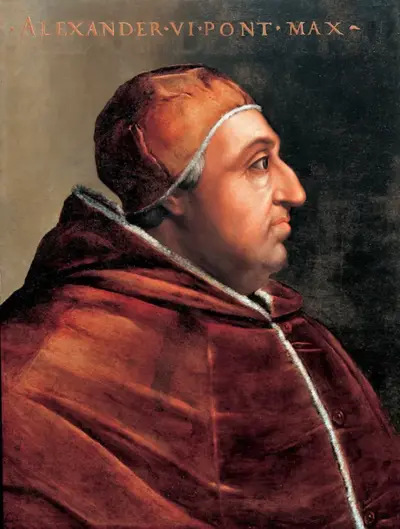
Pope Alexander VI, was pope from 11 August 1492 until his death in 1503. Born into the prominent Borgia family in Xàtiva under the Crown of Aragon (now Spain), Rodrigo studied law at the University of Bologna. He was ordained deacon and made a cardinal in 1456 after the election of his uncle as Pope Callixtus III, and a year later he became vice-chancellor of the Catholic Church. He proceeded to serve in the Curia under the next four popes, acquiring significant influence and wealth in the process. In 1492, Rodrigo was elected pope, taking the name Alexander VI.
