Walter Cronkite Quotes
We need not only an executive to make international law, but we need the military forces to enforce that law and the judicial system to bring the criminals to justice before they have the opportunity to build military forces that use these horrid weapons that rogue nations and movements can get hold of - germs and atomic weapons.
Cronkite, Walter. "Speech to the World Federalist Association." 19 Oct. 1999.


This statement told the world that the United States might preemptively attack Iraq because the Iraqis were developing nuclear weapons. Bush ordered the invasion of Iraq and there it turned out that was no nuclear program of any type in Iraq. There has been a debate ever since as to whether Bush and his key advisors lied knowingly to justify a war they wanted, wanted the war and pressured the intelligence agencies to warn of a clear nuclear development program, or were duped by incompetent intelligence agencies. While American troops were bogged down in Iraq, North Korea tested a nuclear weapon and Iran announced an enrichment program for weapons grade.

This quotation represents a colossal failure of politicians to understand science and the way that it works. They assumed that the processes and methods were secrets that if kept secret, would prevent others from constructing an atomic bomb. The reality was that the most important “secrets” had emanated from Einstein’s Theory of Relativity and other published scientific papers. So any competent physicist knew immediately how the bomb worked. A triggering mechanism would need to be developed but that was just a complicated engineering project. The largest barrier was the supply of enough radioactive material with sufficient purity. That then (as today) took a lot of money and some time. But after the initial bomb, the secrets might speed things up but were not necessary. That is why the French and the Russians quickly developed their bombs, and why it did not take the Israelis long once the had decided to invest the resources. China, India and Pakistan did not need the secrets either when much later, they decided to develop nuclear weapons. With the atomic bomb, spying and obtaining secrets shorten the required time and reduce the cost, but are not necessary. This is why nuclear proliferation is so hard to stop.

Bethe was the head of the Theoretical Division of Los Alamos and was one of the Senior Scientists who developed the Atomic Bomb. At the time, he was very enthusiastic about scientists helping to stop the Germans and Japanese from winning WWII. He had been a refugee from Nazi Germany and became a great American Patriot. However, when there were tens of thousands of nuclear weapons—enough to destroy the entire population centers of the earth several times over, he urged a reduction and finally made this plea the year before he died. See {628438} for a recent expression of the principle of individual scientist’s responsibility.

Asking Congress for authority to use military force to punish the Syrian government for killing thousands of its own people with saran gas in the Syrian Civil War

Fermi was the scientist who organized and planned the first controlled nuclear chain reaction as a part of the Manhattan Project and was one of the major scientific advisors to the Atomic Energy Commission until he, Oppenheimer, and several other scientists opposed the development of the Super (the name Edward Teller had given to the proposed hydrogen bomb). The scientists knew that we had and could make enough atomic bombs to destroy any nation and to make it doable with just a few bombs as opposed to many they saw as of little military
value. They further expected that the Russians and some others would be forced to keep up with us in an arms race and that the bomb would never be able to be used without retaliation in kind and the destruction of most of America. The politicians and military did not really believe that the Russians had the scientific capability to develop hydrogen weapons and some thought if we had them and no one else did, we could dictate a “pax Americana” to the world. Others feared that Russia or some other country would develop a hydrogen weapon and then dictate to us. We did have a monopoly on the Super for a few years and America never dictated to the rest of the world. When other countries developed the weapons, we entered the era of Mutually Assured Destruction (MAD).


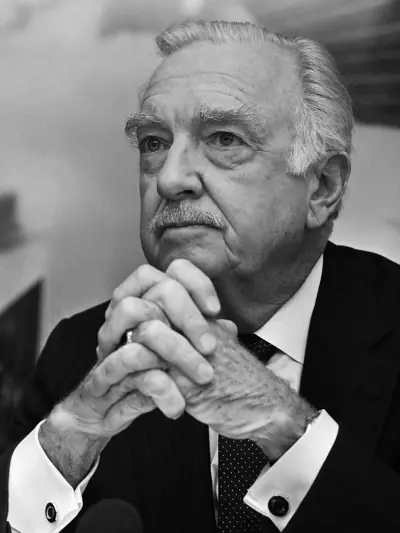
Walter Leland Cronkite Jr. was an American broadcast journalist who served as anchorman for the CBS Evening News for 19 years (1962–1981). During the 1960s and 1970s, he was often cited as "the most trusted man in America" after being so named in an opinion poll. Cronkite reported many events from 1937 to 1981, including bombings in World War II; the Nuremberg trials; combat in the Vietnam War; the Dawson's Field hijackings; Watergate; the Iran Hostage Crisis; and the assassinations of President John F. Kennedy, civil rights pioneer Martin Luther King Jr., and Beatles musician John Lennon. He was also known for his extensive coverage of the U.S. space program, from Project Mercury to the Moon landings to the Space Shuttle. He was the only non-NASA recipient of an Ambassador of Exploration award. Cronkite is known for his departing catchphrase, "And that's the way it is", followed by the date of the broadcast.
