Sun Yat-sen Quotes
We must wait for the official history of the Chinese Revolution to record in greater detail the invaluable work of our Japanese friends.
Sun, Yat-sen. Memoirs of a Chinese Revolutionary. George Allen and Unwin, 1927, p. 189.


The Communists under Mao won the Civil War easily as the Nationalists were not only corrupt and very unpopular, but they were not very interested in the welfare of the Chinese peasants. Further Chiang was a ruthless dictator. At the time there was great pressure for America to support any faction that was anti Communist regardless of how bad they were themselves. Davies and others who thought that we should have communications with the Communists who would soon control China, were viciously attacked by Senator McCarthy who accused Davies of “loosing China” and the Senator and some other Americans thought that the Nationalists could win the Civil War. We now know that they never had a chance, but at the time they did a very good job of promoting their cause and capability in the United States and especially in Washington. None the less, in the Red Scare, Davies was fired, only to thereafter be awarded the highest civilian award in the nation in recognition of his great and patriotic work.
Many American ideologues assumed that the Chinese Communist Revolution would lead to an economic collapse. They did not realize that historically a competitive business economic system had been operational in the Chinese culture for thousands of years. In reality the economy was however really being suppressed somewhat by the Mau style of communism. When Deng loosened up the economic rules in China, their “Communist” system not only functioned as it had under Mao, but then thrived and China became a world economic power in just a relatively few years.

This was just a month after the Japanese sneak attack on Pearl Harbor. Anyone at that time, who promised to attack Japan would get a serious hearing, and Chiang Kai-shek and the China Lobby were making extraordinary promises. FDR wanted to give Chiang’s Nationalist government an extraordinary $½ Billion in aid. One interesting aspect of this quotation is the wording. Note that the President used the word “invent”. He realized that there was no existing mechanism whereby they could simply send such a huge block of money to a foreign country on the promise that they would use it for fighting the Japanese. If there were, he would have had the War Department or the State Department to do it. So he asked his most trusted and creative cabinet member to “invent” a way to do it. Morgenthau came through with a very complicated, elaborate scheme that Congress approved the following week. The money was sent, but Chiang Kai-shek did not spend it all for fighting the Japanese—his idea was to let the Chinese Communists under Mao wear themselves down fighting the Japanese, and Chiang could use the American military assets to then wipe out the communists, his only political opponents. See {641676}.


The Vatican & the Chinese Communist Government had been at odds for years with much of the Chinese church going underground. Fr. Jin had been jailed for a decade. Then the government allowed him and the Catholic Church and operate openly, but there were still Vatican conflicts over numerous issues including the right of the Government to approve senior appointments of church officials—a privilege the church claimed exclusively. The Vatican ordered Jin not to cooperate and especially not to reopen the national theological seminary which the government had ordered closed. There had been no training for Chinese priests and Jin wanted to reopen the national theological seminary but the Vatican refused cooperation waiting for the government to capitulate to the Vatican’s various demands. Fr. Jin defied the Vatican & reopened the seminary. Without officially admitting their failed tactics, the Vatican let the discipline issue against Jin drop & the national theological seminary thrived.

The early revolutionary Chinese Communists had a much more democratic and civil-liberties oriented view of government than after the had won and gained control of China. Then the problems were so enormous with such meager resources that the insecurity of the party government let to a civil rights flip flop and a politically authoritarian government. Stability is today the most important priority for the Chinese Communist party so that free speech, protests and other civil liberties are curtailed. Economic development is the more important activity and political development is lagging, but while economic development is racing ahead, Chinese political development improves only slowly. Dissidents like Liu Xiaobo are pushing the process.
It was Mao whose brilliant leadership defeated Chiang and forced him give up China and flee to Taiwan. It was not Mao’s military ability, but his understanding of the Chinese people and how to lead and motivate them that enabled him to be victorious. Chiang, the better general and military tactician, was a strategic failure and his only experience with the average Chinese person was to rule, intimidate and command him.


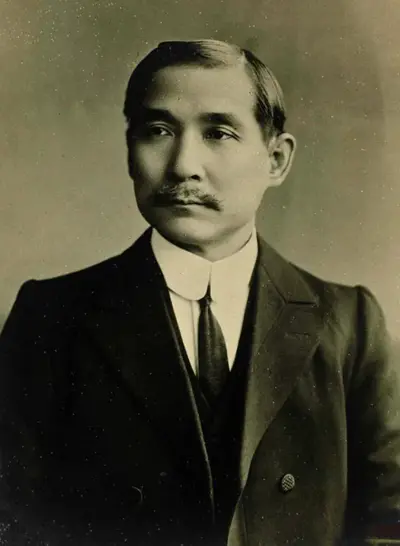
Sun Yat-sen was a Chinese statesman, physician, and political philosopher, who served as the provisional first president of the Republic of China and the first leader of the Kuomintang (Nationalist Party of China). He is referred as the "Father of the Nation" in the Republic of China, and as the "Forerunner of the Revolution" in the People's Republic of China for his instrumental role in the overthrow of the Qing dynasty during the Xinhai Revolution. Sun is unique among 20th-century Chinese leaders for being widely revered in both mainland China and Taiwan.
