Mao Zedong Quotes
The Great Leap Forward
Mao Tse-Tung, 1893-1976, Chairman, Communist Party of China, Chinese Revolutionary Leader & Political Philosopher, Founder, The People's Republic of China, Name given to Mao’s industrialization program, 1958
Sourced by: Eigen's Political and Historical Quotations


Many American ideologues assumed that the Chinese Communist Revolution would lead to an economic collapse. They did not realize that historically a competitive business economic system had been operational in the Chinese culture for thousands of years. In reality the economy was however really being suppressed somewhat by the Mau style of communism. When Deng loosened up the economic rules in China, their “Communist” system not only functioned as it had under Mao, but then thrived and China became a world economic power in just a relatively few years.


Chaing Kai Chek seemed to have the Red Army on the run with far more guns, planes & men. However while Chaing thought he was chasing the Communists, the Red Army traveled through 11 major Chinese provinces, helping the peasants to harvest their crops, build their homes, care for their sick & get indoctrinated in Communist political philosophy. In comparison, the Chaing forces abused the peasants, corruptly stole from them & brought no improvement in their living standard, sense of hope or fairness. Massive retreat became massive victory as so much of China had a Chance to compare the communists with the Kuomintang & unfortunately chose communism as Chaing and the Kuomingtang was such a poor example of capitalism-corrupt, ineffectual and heartless. At the same time, Mao and the other communist leaders were brilliant in their use of the retreating army to improve the lot of the peasants and left their biggest supporters as they were driven to the next province and repeated the process.

Stalin decided not to help the Republicans in Spain—even his fellow communists.
The Communists under Mao won the Civil War easily as the Nationalists were not only corrupt and very unpopular, but they were not very interested in the welfare of the Chinese peasants. Further Chiang was a ruthless dictator. At the time there was great pressure for America to support any faction that was anti Communist regardless of how bad they were themselves. Davies and others who thought that we should have communications with the Communists who would soon control China, were viciously attacked by Senator McCarthy who accused Davies of “loosing China” and the Senator and some other Americans thought that the Nationalists could win the Civil War. We now know that they never had a chance, but at the time they did a very good job of promoting their cause and capability in the United States and especially in Washington. None the less, in the Red Scare, Davies was fired, only to thereafter be awarded the highest civilian award in the nation in recognition of his great and patriotic work.

The early revolutionary Chinese Communists had a much more democratic and civil-liberties oriented view of government than after the had won and gained control of China. Then the problems were so enormous with such meager resources that the insecurity of the party government let to a civil rights flip flop and a politically authoritarian government. Stability is today the most important priority for the Chinese Communist party so that free speech, protests and other civil liberties are curtailed. Economic development is the more important activity and political development is lagging, but while economic development is racing ahead, Chinese political development improves only slowly. Dissidents like Liu Xiaobo are pushing the process.
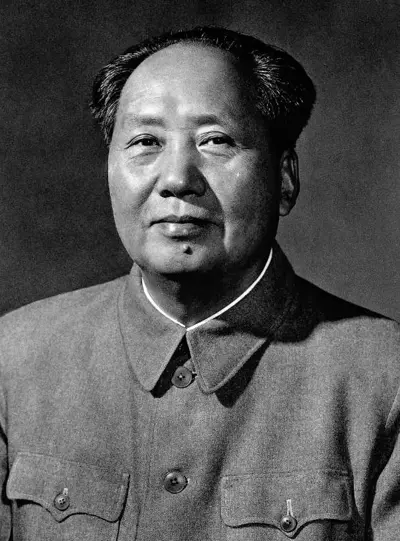
Mao Zedong, also known as Chairman Mao, was a Chinese communist revolutionary who was the founder of the People's Republic of China (PRC), which he ruled as the chairman of the Chinese Communist Party from its establishment in 1949 until his death in 1976. Ideologically a Marxist–Leninist, his theories, military strategies, and political policies are collectively known as Maoism.
