Huey Long Quotes
We have trouble, my friends, in the country, because we have too much money owing, the greatest indebtedness that has every been given to civilization … Two hundred and seventy-two thousand millions of dollars of debts are owed by the various people of this country today. Why, my friends, that cannot be paid. It is not possible for that kind of debt to be paid.
Huey P. Long, 1893-1935, Louisiana Governor, U.S. Senator (Democrat, LA), Speech, “Every Man a King,” February 23, 1934
Sourced by: Eigen's Political and Historical Quotations


The Congressman was notorious for his extreme and unusual views of things. See {606976} for another of his extreme statements which turned out to be untrue. McFadden quotations are sometimes used to show that there is almost no limit to how absurd a view a politician in general, or a member of Congress in particular, might take and make public.

Debts accumulated by the allies in World War I was still outstanding a decade later. When it was proposed that the United States help reduce this debt, President Coolidge remarked:
_0_thumbnail_47x47.jpg "Bill White, Mayor of Houston, Texas")

The Puerto Rican debt for all the bonds they had issued was so great that there was no realistic prospect for paying it back on schedule and paying the interest. So he announced that Puerto Rico might repudiate the debt and default.


Although this was written in 1924, it could have been written at most times since where the national debt was substantial.


Greece, as a Euro member of the European Union, was able to borrow large amounts of money. However, most of it disappeared as the result of massive corruption and huge waste. The Greek government, to mask the facts, produced false economic reports to the European Union and other lenders. When this was discovered, no one was willing to lend money to Greece until there were major reforms.


See {604501} for another of his statements. It was Alexander Hamilton who called the national debt a national blessing. See {207891}. Jackson was convinced that a moneyed class who held the national debt could dictate to any administration by threatening to not renew their bonds. The same concern was expressed at the beginning of the 21st century regarding the Chinese and the Middle Eastern countries which held do many of our bonds.


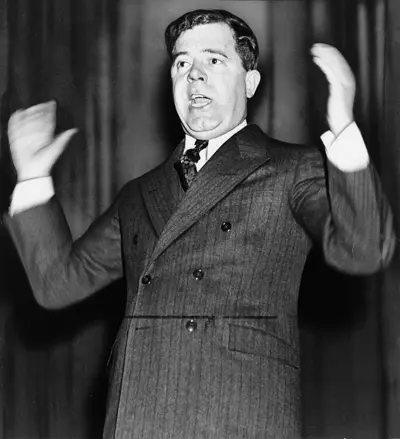
Huey Pierce Long Jr., byname "The Kingfish", was an American politician who served as the 40th governor of Louisiana from 1928 to 1932 and as a member of the United States Senate from 1932 until his assassination in 1935. He was a populist member of the Democratic Party and rose to national prominence during the Great Depression for his vocal criticism of President Franklin D. Roosevelt and his New Deal, which Long deemed not radical enough. As the political leader of Louisiana, he commanded wide networks of supporters and often took forceful action. A controversial figure, Long is celebrated as a populist champion of the poor or, conversely, denounced as a fascistic demagogue.
