Zelimkhan Yandarbiyev Quotes
We are determined to establish a state based on Islamic values and laws that will serve as a base for the further expansion of Islamic influence…. All those who seriously deal with the issues of Chechnya and the Caucasus realize what our role is. As is the case with all important periods in history, the Chechen people are today playing a central role in the process of determining basic orientations of development in the Caucasus region, particularly its northern parts. They are defining the nature of the Russian-Caucasian relations. To a certain extent, our dealings with Russia indicate the likely course of development in relations between Moscow and the rest of the Caucasian peoples
Zelimkhan Yandarbiyev, 1953-2004, Islamic Terrorist Revolutionary Leader of Chechnya, Quoted in Yossef Bodansky, Chechnya: The Mujahedin Factor
Sourced by: Eigen's Political and Historical Quotations

Jinnah and other Muslim leaders had stirred up the Muslims to violence to put pressure on all the parties to accede to Jinnah's Muslim League's demand of an independent Muslim nation—Pakistan. Messervy was very sympathetic to the Muslim leadership as he had been feuding with and frustrated by the predominantly Hindu ruling Congress Party. After partition he accepted the mercenary position of Commander in Chief of the Pakistani Army. Then he was shocked and horrified at the slaughter of the terrorist attacks by the Muslims—about 4,000 Sikh men, women and children had been beaten and cut to death. The Sikhs had been targeted largely because Sikh leaders had recently announced that if there were a Partition, Sikhs would refuse to live in nation under Muslim control.


This vision, known as "The Third Rome" saw not only Moscow as the seat of Christianity for the world, but saw the Czar as the Head of the Christian unified Church. Constantinople had fallen to the Muslims and Rome to the Barbarians and the Pope had virtually no power at the time. Particularly interesting is his vision of transforming a civil Emperor to the head of the Church—one who was strong and wealthy enough to end the schism of the Eastern and Western Churches and command all. In this sense, he was following the Muslim concept of a single secular and religious, all powerful, leader—like the Caliph.


Singh turned him down. Note that even before Pakistan was a country, Jinnah and other Muslim leaders had hopes of grabbing much of India as the British partitioned it, and have been trying to do so ever since the inception of Pakistan

Two months earlier, Jinnah and the Muslim League had, behind the scenes, orchestrated and abetted vicious, murderous, terrorist attacks on Sikhs by Muslim tribesman brought into the Punjab for the purpose." Master Tara Singh


The quotation is self explanatory except for the “curriculum” and “manliness.” The curriculum refers to the Saudi Arabian fundamentalist Wahabi educational curriculum that has been sent all over the world, including the U. S. These tech hatred and violence. America and most non Islamic countries have put great pressure on Islamic groups not to use these extremist materials. To Kharabshe, this in itself is a sin because he sees this curriculum as the authentic and proper one. See {606337} for an example of the violence in the curriculum. He and many like him believe that the attempts by Western nations to provide any rights for women beyond what they have under the Koran diminishes the manliness of Islamic men who would become the victim of these females who would not be under proper control of the men.


Islamic fundamentalist terrorists demanding an independent Islamic state in the middle of Russia had terrorized the people of the capital extorting money, beheading people and stealing property to fund their activities. The Russian military came in to attack the terrorists but with such a heavy hand that they did not distinguish very well between the terrorists and the regular civilian population, even torturing inhabitants suspected of aiding the terrorists when the suspects themselves had been tortured and threatened by the terrorists and they had seen many who did not cooperate killed. The people—and especially the women—were caught in the middle.
The “area” was Chechnya, a province of Russia with a substantial Muslim population. Islamic forces were not as unhappy in the Russian Communist days in the Christian Orthodox church was subdued, but after the fall of Communism, the Russian Orthodox church had a revival, and that exacerbated all the independence aspirations that existed for years in Chechnya.

Richard Southwell Bourke. Victoria was then Queen. The role of the Islamic religion in terms of violence, terrorism & rebellion is not uniquely a question of the 21st century. The 19th Century saw much Islamic fundamentalist violence in India and other Islamic Colonies—much more than from other religious groups in similar colonial status. Opinion was divided between those who saw Islam—especially the Wahabi sect—as inciting violence per se. Mayo assigned one of his administrators to do a study of the issue. See {616924} for the study of William Wilson Hunter. Ironically, Lord Mayo was stabbed to death in a terrorist attack on him personally in 1872.

One of the noteworthy aspects of this quote is a fundamental intellectual clash. Al-Quaeda and other Islamic fundamentalists are genuinely very concerned that the West will interfere with their religion and their desire to unite all the Muslims in the world. Ironically, the West prides itself on the tolerance of religion and the freedom for anyone to practice any religion. The West does not see where it is interfering at all with the Muslim religion or its moral precepts. The problem lies in the different perception of ideas. Since about 1100 there has been a closing of Islamic intellectual growth and change. Any idea which is contrary to the orthodox view of Islam is perceived as hurtful or at least dangerous to the Muslim. Individuals in the West question Islamic relation no more than different sects of Christianity, Judaism and other religions. Allowing freedom is not sufficient for this Islamic notion; there must be no exposure to different ideas or examples. For us, no exposure means no freedom. While there are many Muslims which agree with this position, there are also many who disagree completely and believe that Islam is strengthened by exposing Muslims to all the ideas in the world. He was killed by an American air strike that had targeted him.
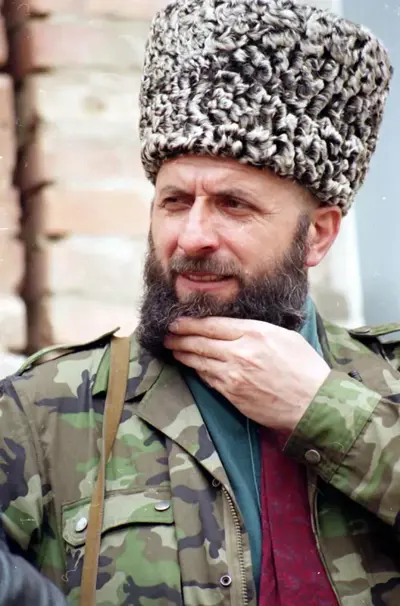
Zelimkhan Abdulmuslimovich Yandarbiyev (Chechen: Яндарбин Абдулмуслиман-кIант Зелимхан Yandarbin Abdulmusliman-khant Zelimxan, Russian: Зелимхан Абдулмуслимович Яндарбиев, also spelled Yandarbiev) was a writer and a politician, who served as acting president of the breakaway Chechen Republic of Ichkeria between 1996 and 1997. In 2004 Yandarbiyev was assassinated while in exile in Qatar.
