Benjamin Franklin Quotes
Want of Money in a Country discourages Labouring and Handicrafts Men (which are the chief Strength and Support of a People) from coming to settle in it, and induces many that were settled to leave the Country, and seek Entertainment and Employment in other Places, where they can be better paid …. A Plentiful Currency will encourage great Numbers of Labouring and Handicrafts Men to come and Settle in the Country
Benjamin Franklin, 1706-1790, Governor of Pennsylvania, Member of the Continental Congress & the Constitutional Convention, Governor of Pennsylvania, President of the Pennsylvania Assembly, U.S. Minister to France, Postmaster General of the American Colonies, A Modest Enquiry into the Nature, and Necessity of a Paper-Currency, 1729
Sourced by: Eigen's Political and Historical Quotations

All money has based on the Gold Standard then. But the economic output of the American colonies was increasing rapidly. If the money supply stays fixed, there is a shortage of money and this then inhibits further growth, Franklin realized this and called for an increase in the money supply. He was only 23 years old when he wrote this essay and had these insights.
There must be enough money in circulation so that all people who want to buy things will have a vehicle for paying for it else people would be reduced to barter and tade—a much less efficient mechanism. Note the importance that Franklin gives to being able to attract immigrants. This was considered extremely important in colonial America. Immigration was the main engine of growth and development. Many believe that it still is.


At the time, the economy was virtually controlled by the banks and others in the finance, as opposed to businesses that produced things or provided non-financial services to consumers and business which was that had prevailed ever since the Great Depression, when New Deal legislation controlled the banks, stock markets, and other facets of the financial industry.


The alternative would have been for the colonies to borrow English money at high interest rates and use that. Or use money from private banks (which occurred later.) Many conservatives are today a little shocked that some of the American Colonies just printed money with no backing but it worked—at least at the local level. A Boston Bank for example, would take a large commission for a Bostonian to convert Pennsylvania money into Massachusetts money. So it was not a very good system for trade between colonies and International trade. But English money was used for that. The colonists pragmatically got the “best of both worlds” and paid as little interest as they needed to. This system is essentially what we use today on a national scale with no gold or silver backing of the money.


His prediction was accurate and the consequence was an increase in the production of agricultural products and a shrinking proportion of Americans employed in farming and ranching.

There has always been a fear of inflation and currency debasement by governments. Since ancient times, rulers issued coins and when they were made of cheap metals like copper or iron, the ruler could mint as much as he wanted and when he did so the value went down. By using only precious metals, gold and silver, for coins, there would be a natural restraint on government. Garfield was one of those who believed that we should always have money of gold and silver. The United States would use that principle for the next century even backing its paper money with gold and silver. In the Nixon administration the United States abandoned the gold standard. Today, it is the ability of a country to produce things that maintains value of paper money which has been supplanted in many cases by electronic money.

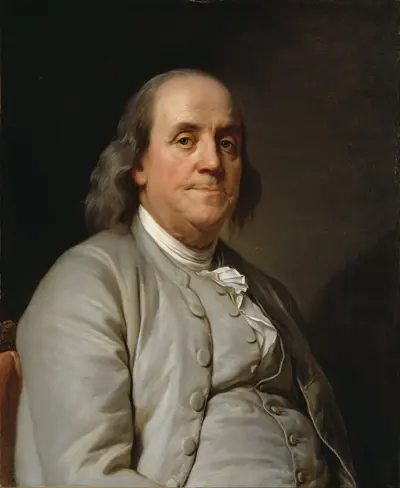
Benjamin Franklin FRS FRSA FRSE was one of the Founding Fathers of the United States. A polymath, he was a leading writer, printer, political philosopher, politician, Freemason, postmaster, scientist, inventor, humorist, civic activist, statesman, and diplomat. As a scientist, he was a major figure in the American Enlightenment and the history of physics for his discoveries and theories regarding electricity. As an inventor, he is known for the lightning rod, bifocals, and the Franklin stove, among other inventions. He founded many civic organizations, including the Library Company, Philadelphia's first fire department, and the University of Pennsylvania.
