Rexford Tugwell Quotes
To the extent that these [New Deal policies] developed,
they were tortured interpretations of a document
[the Constitution] intended to prevent them.
Tugwell, Rexford G. "The Compromising Roosevelt." The Western Political Quarterly, vol. 6, no. 2, June 1953, p. 320.


This was the statement that caused many senators to block her appointment as a Federal judge.


Even today, there are thousands of infrastructure improvements and beautifications that were made by people working for the government when there were no private jobs available, that we can view and use from the Great Depression programs of the New Deal.

This has been the conventional wisdom in American politics. However, George W. Bush not only had a small majority in Congress but he had garnered fewer popular votes than his opponents, but won with the electoral college. None the less, he massively cut taxes, mostly for the rich, and changed from the balanced budget to huge deficit spending. He pushed a major drug insurance program through and even tried to privatize Social Security. Obama, the next president had a substantial majority for his party and had a broad mandate, but in his reform issues he had very slim majorities. He went ahead anyway and in his first term he passed stunning and substantial reforms including Health Care Reform and Financial Regulation Reform. These reforms may or may not be able to be enforced in the future. See {625493} for a similar view.


Hoover, a brilliant administrator before his presidency, was so ideological about the role of government that when the Great Depression came, he was unwilling to use government directly to cope with the new problems. He was turned out of office in favor of FDR and the New Deal which the voters ratified 4 times. Hoover was embarrassed by the New Deal successes and lashed out with many insults. In this case, he called the New Deal “fascist”. See {629055} for another quote where he labels the New Deal communistic. Ironically, Hoover is rated by most historians as one of the least effective Presidents in American history while Roosevelt is always rated among the top 3 presidents.

This statement was a total reverse of his predecessor’s policy. Hoover stubbornly refused to consider any direct relief for workers on the philosophical ground that it would weaken their character, make them dependent, and provide benefits for the people who were not working so the motivation to work would be lessened. When FDR pronounced this on the radio, it dramatically reversed U. S. policy and gave many people hope that the government might do something about the depression rather than just wait out the business cycle.


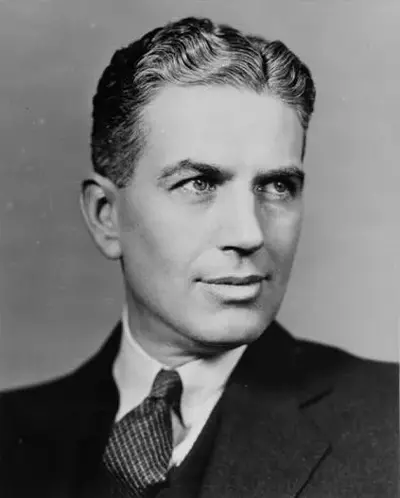
Rexford Guy Tugwell was an economist who became part of Franklin D. Roosevelt's first "Brain Trust", a group of Columbia University academics who helped develop policy recommendations leading up to Roosevelt's New Deal. Tugwell served in FDR's administration until he was forced out in 1936. He was a specialist on planning and believed the government should have large-scale plans to move the economy out of the Great Depression because private businesses were too frozen in place to do the job. He helped design the New Deal farm program and the Resettlement Administration that moved subsistence farmers into small rented farms under close supervision. His ideas on suburban planning resulted in the construction of Greenbelt, Maryland, with low-cost rents for relief families. He was denounced by conservatives for advocating state-directed economic planning to overcome the Great Depression.
