William Petty Quotes
To prohibit the Exportation of Money, in that it is a thing almost impracticable, it is almost nugatory and vain.
Although this has been well known for centuries. Nonetheless, many nations have attempted it over the years with none being successful.
William Petty, 1623-1687, English Economist & Demographer, A Treatise of Taxes & Contributions, 1662
Sourced by: Eigen's Political and Historical Quotations


Iceland's economy collapsed in the Meltdown of 2008. Their largest banks failed completely as they had engaged in the same kind of risky investments as the American banks had. Their government however did not have the assets to bail their banks out. So they let the banks fail and protected the small depositors with their limited assets. They then devalued their currency drastically, making their fishing and other products a great bargain for other nations of the world and though humiliated the Islanders started getting jobs as demand for Islandic exports grew. Some Icelanders who owned companies were making a great deal of money. Taxes were raised for high income citizens. To prevent the money being taken out of the country and invested so that the jobs would not benefit Icelanders or the earnings were not as taxable in Iceland, the nation imposed Capital Controls—no money was allowed to be taken out of the country except small amounts for business travel expenses. Iceland recovered rapidly and by 2015, at which point the Minister of Finance felt that the country was losing more than it was gaining, so it was time to end the Capital Controls.

This objective finally reached its peak in the Nixon administration when the U. S. went off the gold standard. 75 Years after FDR tried to make the U. S. dollar more resilient, America had been so successful that many foreign governments having the same problem of little or no control over their currency, have pegged their currency to the U. S. dollar, thus gaining our stability.

The Hoover administration had lost control of the economy. The nation was in a depression. Banks were failing. Gold was being hoarded and taken out of circulation while we were on the gold standard. Roosevelt’s solution was to decouple American money and gold—a solution that William Jennings Bryan had suggested many years earlier. See {640978}.
FDR was then a candidate for the Democratic Vice Presidential Nomination. This statement shocked some of the conservative French and British delegates and officials such as Ramsay MacDonald, Georges Bonnet, and Neville Chamberlain, but economist John Maynard Keynes strongly approved of Roosevelt Roosevelt’s statements. At issue was whether or not the major currency powers should confer frequently and set the international currency exchange rates or should the rates float and be determined at any point by the free market in currency. FDR held the latter view which was opposed to the positions of the conservative banker-oriented delegates from the European counties, However Roosevelt’s statement was considered “harsh” and “vituperative” by the conservatives and the entire conference collapsed over them. FDR admitted that perhaps he had been too strong and blunt in his language. An irony of this quotation is that 80 years later the positions of liberals and conservatives had both flip-flopped. It became the conservatives who adopted the FDR free market for currency exchange while many liberals called for government intervention and agreement on exchange rates to prevent instability.
Roosevelt saw to it that the contents of the telegram was shown to the press. Then this statement was seen by the foreign delegates who viewed themselves as ‘international bankers”. They were outraged and the conference blew up with no significant action taken. Roosevelt was desperately trying to lead America out of the Great Depression which Herbert Hoover had left him with. The dollar had been falling in value since the 1929 crash and one of the likely outcomes of the conference was European and other nations putting a plan together to stop the fall of the dollar. FDR however, wanted the dollar to continue to fall. This would make it harder for Americans by buy imported products, but easier to employ more Americans making products for export. The people hurt most by The Depression did not buy any imported products, and what they needed was food, housing, clothing, education and medical care, none of which would be affected by a weaker dollar and more expensive imports. However, he did not want a political argument with the wealthy and upper middle class who wanted cheaper imports, so some people believe that he made it seem that he had committed a diplomatic blunder and that caused the conference to collapse.


“Pegged” exchange rates are a country’s money where the Government sets the value of the money in terms of some other currency—usually American dollars. The advantage of a pegged currency is that it is stable and does not fluctuate day to day. The disadvantage is that people realize that the value is artificial and other countries will not accept the pegged currency. Worse natives try and get as many dollars as they can because the fear that the Government will devalue and change the rate of exchange of the pegged currency.
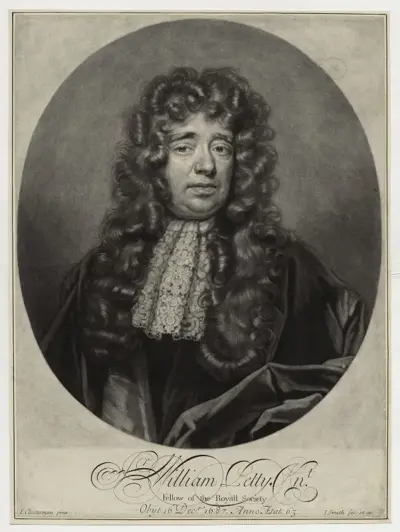
Sir William Petty FRS was an English economist, physician, scientist and philosopher. He first became prominent serving Oliver Cromwell and the Commonwealth in Ireland. He developed efficient methods to survey the land that was to be confiscated and given to Cromwell's soldiers. He also remained a significant figure under King Charles II and King James II, as did many others who had served Cromwell.
