Eleanor Roosevelt Quotes
This living in a democracy is a problem, isn't it?
In many ways living under tyranny is quite easy as there are few choices that the citizen must make. As hard as it is for us to imagine today, while her husband was President of the United States, the First Lady wrote a nationally syndicated newspaper column every single day with politics frequently the subject. While she usually agreed with the President, there were occasions where they seemed to not see things exactly the same. She tended to be more liberal than he. However, there were those who believed that when she criticized politicians, it was with FDR’s knowledge and blessing and she sometimes did his “dirty work.” Eleanor Roosevelt was one of the most influential people in the country—certainly more-so than any First Lady before and since.
Eleanor Roosevelt, 1884-1962, First Lady (Franklin Delano Roosevelt), U. S. Delegate to the United Nations, Newspaper Column, My Day, June 18, 1941
Sourced by: Eigen's Political and Historical Quotations


This quotation illustrates the "winner take all" conceopt of many political cultures that call themselves and think of theselves as a democracy. But a true democracy does not allow a tyranny of the majority--especially a very narrow minority.


A major problem of new and emerging democracies is that many people believe that majority rule per se is democracy. In Egypt for example, Morsi and his Muslim Brotherhood won the election. They then assumed that they had the right to do anything including exempting the government from judicial review or deciding the role of women in society or denying freedom of religion to non-Muslim citizens. Democracy is not a serial autocracy with each new autocrat being selected by a free and fair election.

After the many years of the Cold War attacking of Democracy, for many Russians the word conveys a bad image of their old enemy. For others, using the word reminds them that the Soviet Union collapsed and the Russians lost the cold war—an unpleasant memory. Yet many of the leaders of the Russian Federation very much wanted to democratize Russia. Bushmin had this very practical, albeit humorous, solution.

Kishi was an ultra conservative who was one of the politicians who signed the Declaration of War against the U. S. and then served in the Japanese War Cabinet and was the Minister of Commerce and Industry. In the latter post he presided over and made policies about the utilization of slave labor and brutal and illegal treatment of prisoners of war. After Japan’s surrender he was jailed as a “Class A” war crimes suspect along with several other cabinet ministers. In 1948, General MacArthur decided not to prosecute the Cabinet Ministers as he had decided not to prosecute the Emperor Hirohito. His brother was the secretary to the prime minister’s cabinet who had arranged a job for him. However, all the people in government were now building a democratic government. Being a right wing pro military, pro empire politician was no longer feasible and he discovered all his ex-colleagues who hated democracy before were now extolling its virtues. He went with the flow, and reorganized his political constituency, and gained control of the Diet, but now they were all democrats. Then he became prime minister. He was an ardent anti-communist and the Cold War was raging so his previous right wing dictatorial, pro war positions and his war crimes were overlooked by MacArthur and the allies.

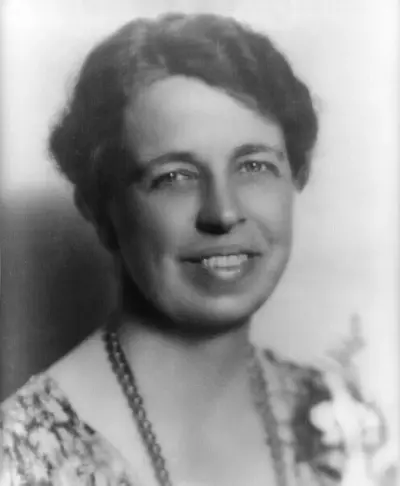
Anna Eleanor Roosevelt was an American political figure, diplomat and activist. She served as the First Lady of the United States from March 4, 1933, to April 12, 1945, during her husband President Franklin D. Roosevelt's four terms in office, making her the longest-serving First Lady of the United States. Roosevelt served as United States Delegate to the United Nations General Assembly from 1945 to 1952. President Harry S. Truman later called her the "First Lady of the World" in tribute to her human rights achievements.
