Mark Twain Quotes
There are wise people who talk ever so knowingly and complacently about "the working classes," and satisfy themselves that a day's hard intellectual work is very much harder than a day's hard manual toil, and is righteously entitled to much bigger pay. Why, they really think that, you know, because they all know about the one, but haven't tried the other. But I know all about both; and as far as I am concerned, there isn't money enough in the universe to hire me to swing a pickaxe thirty days, but I will do the hardest kind of intellectual work for just as near nothing as you can cipher it down--and I will be satisfied, too. Intellectual "work" is misnamed; it is a pleasure, a dissipation and its own highest reward. The poorest paid architect, engineer, general, author, sculptor, painter, lecturer, advocate, legislator, actor, preacher, singer, is constructively in heaven when he is at work; and as for the magician with the fiddle-bow in his hand who sits in the midst of a great orchestra with the ebbing and flowing tides of divine sound washing over him--why certainly, he is at work, if you wish to call it that, but lord, it's a sarcasm just the same. The law of work does seem utterly unfair--but there it is, and nothing can change it: the higher the pay in enjoyment the worker gets out of it, the higher shall be his pay in cash, also.
Samuel Langhorne Clemens, 1835-1910. This quotation had even more meaning a century later when the gap in wages between a knowledge worker and a manual worker had increased many fold.
Mark Twain, Writer, Founder, Anti-Imperialist League, A Connecticut Yankee in King Arthur's Court
Sourced by: Eigen's Political and Historical Quotations


They lost. Sweden had a combination of a high standard of living, a very robust and effective social safety net and a high marginal income tax rate. For Swedes who do not work, life is far better than for employed people in most other countries. For those who work, they pay a large proportion of their earnings as taxes. So the very hard worker is left with comparatively little advantage over non workers. Conservatives have always warned that this is a formula for economic stagnation as few people will work. The reality in Sweden and a few other nations, is that the vast majority of the Swedes choose to work—but they work not to survive, but for reasons which range from interest in their work, the social interaction of the workplace, the desire to create things and make a difference in society. Even in America there are many who work who do not need the money and are motivated by non-monetary factors.

One of the vestiges of slavery in the South was the negative image that any kind of manual labor had. For whites, that is what slaves did, and for many still “should do”—not whites. For the Blacks, manual labor is what they had been forced and lashed to do, and “slowing down” their productivity was one of the only ways of rebelling. To work hard had been to capitulate to terror and evil. Both races and the economy of the South would suffer for more than a century after the civil war and in some parts of the South the attitudes were reflected into the 21st century.

While it was true that wages did not increase beyond inflation, the enormous increase in productivity—about a doubling—was not only due to the workers but was also due to the capital investment that the companies made in computers, robots, job restructuring, advanced training, and other management initiatives. Historically, when there are substantial productivity increases, the benefit is shared between the workers and the company as both were necessary to produce the increase in productivity. But since 1980, the workers have not obtained any significant share of the productivity increase.


Her company employed white collar writers, editors, computer programmers and engineers, statisticians, and medical personal who conducted research and training programs for government and private institutions. See {619265} for a concurring view from the nation’s leading productivity expert.


This quotation is very important because it helps readers to understand the problem that the Native Americans have had dealing with land treaties and transactions and the difficulty many Native Americans have had with the concept of paid jobs and working for hire—hence being very successful in a European style capitalistic economy.
He did not comment on why women who work overtime and outdoors or nights and weekends on risky jobs make less than the males who do the same.


The minister was the leader of a sect that had emigrated from Germany to the new colony of George where slavery had been banned but wealthy planters were pointing to South Carolina north of them where slavery was producing riches for the slave owners and asking the Trustees back in England to allow slavery as they were at a competitive disadvantage. Oglethorpe, the leader of the community argued against slavery and was joined by other community leaders including Reverend Boltzius, The argued that slavery would curtail the opportunity for common white men. In this quote Boltzius pointed to Charlestown South Carolina to show the effect that slavery produced there. The wages for slaves, were wages paid to the slave’s owner. While plantation slavery was the most common form of slavery, but many slave owners without large plantations simply rented out his slaves. In some cases, the slaves were taught trades like carpentry so the owner could receive ore for his work. But the system allowed the slave owner to undercut the market, and all a white worker could make was the wage that slave owners were demanding for slave labor.

Ten cents a day was a very low wage—it was about the equivalent of a meal at a tavern at the time. Workers throughout the country were outraged and give him a derogatory nickname—see Quotation 643585.


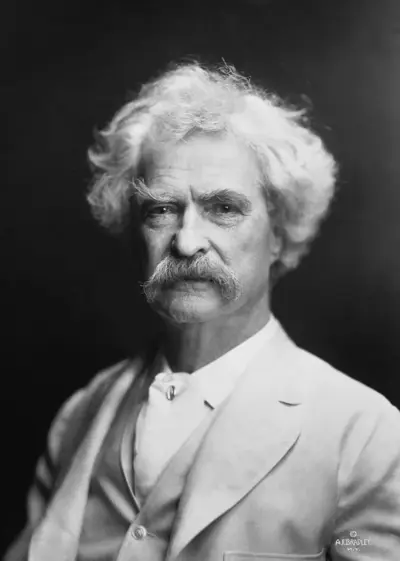
Samuel Langhorne Clemens, known by his pen name Mark Twain, was an American writer, humorist, entrepreneur, publisher, and lecturer. He was lauded as the "greatest humorist the United States has produced," and William Faulkner called him "the father of American literature". His novels include The Adventures of Tom Sawyer (1876) and its sequel, the Adventures of Huckleberry Finn (1884), the latter often called "The Great American Novel".
