Mark Hanna Quotes
There are two things that are important in politics. The first is money, and I can't remember what the second one is.
Hanna, managing William McKinley’s Presidential Campaign against William Jennings Bryan, outspent is opponents by a factor of ten to one. Few understood that at the time or the profound effect that money could play in national politics. Hanna was a political strategist far ahead of his time.
Mark A. Hanna, 1837-1904, Chairman, Republican National Committee, U. S. Senator (Republican, OH), 1895
Sourced by: Eigen's Political and Historical Quotations


Chung was convicted for illegal campaign fundraising for the William Clinton administration.
The “party” Wilson referred to was the lobbyists and corporations who would do almost anything to be in his good graces and they poured money into his campaign fund.

Hollings who was one of the senior experienced senators was offended by the degree to which the George W. Bush Administration and the Republican leadership had turned to lobbyists to draft legislation and amendments to pending legislation. Lobbyists often have specialized information that members of Congress do not have, so there has been in modern times communications between lobbyists and members of Congress and their staffs. However, during the Bush Presidency the practice reached an extreme where lobbyists would even write the legislative language and give it to the members in whom they had invested by giving them large campaign contributions and many perks. K Street is the fanciest street in Washington DC with some of the most expensive office space. A substantial proportion of the lobbyists have K Street offices, hence the metaphor.


The three richest men in America—John D, Rockefeller, Andrew Carnegie, and Morgan, usually major rivals—had gathered together to decide what to do about William Jennings Bryan, who they viewed as very hostile to business and capitalism. (See {641037} and {641038} for Bryan quotation examples that concerned them.) They agreed to combine their efforts and back William McKinley who was running for the Republican Presidential nomination. In those days, the nominee was chosen by a small group of party leaders and their resources guaranteed McKinley the post. They then put large amounts of money to campaigning against Bryan and for McKinley including dirty tricks, many of which are illegal today. It is not known for certain whether McKinley knew the extent of the involvement of the monopolists, but shortly after assuming the Presidency he cut back on many of the relatively few regulations that then existed to control unbridled capitalism. Their effort went for naught when McKinley was assassinated and Theodore Roosevelt became President. Roosevelt would not be bribed or intimidated, and he did more to control monopolies than even Bryan would likely have.
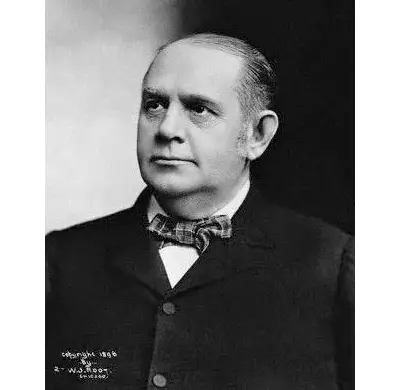
Marcus Alonzo Hanna was an American businessman and Republican politician who served as a United States Senator from Ohio as well as chairman of the Republican National Committee. A friend and political ally of President William McKinley, Hanna used his wealth and business skills to successfully manage McKinley's presidential campaigns in 1896 and 1900.
