Gilbert K. Chesterton Quotes
There are two kinds of people in the world: the conscious and the unconscious dogmatists. I have always found that the unconscious dogmatists were by far the most dogmatic.
Gilbert K. Chesterton, 1874-1936, English Writer, Generally Speaking, 1928
Sourced by: Eigen's Political and Historical Quotations


This turns out to be very much a cultural phenomenon. Amongst educated Englishmen and many scientists and philosophers from America and other cultures but in some cultures opinions stated without passion are often not believed�this is particularly true in the Middle East but exists in many subcultures of America. In science, and the logical philosophy that Russell was so expert in, either you could prove something or you could not. If you could, the passion was unnecessary. If you could not, it was irrelevant. However, in most political issues, except those based on science, most assertions are not provable and although there may be some evidence for a view, it is not determinative. So volume. Bombast, and passion tries to persuade where logic cannot. Russell and many scientists and Philosophers distrust these statements, but the politician must deal with most of them, as public policy must be made whether the issue is scientifically demonstrable or not. Life and society must go on. However, when scientists testify before Congressional committees or in other political arenas, their lack of passion is taken by many as a lack of conviction or a lack of surety, while if they did speak with great passion, they would break the norms of the scientific community in which they work, for it is regarded as unethical to persuade people with anything but the evidence and logic.


The last sentence is the most frequent part of this quote. It is frequency prefaced with “Too often…” which is not part of the original quote.


Political ideologues are particularly vulnerable as doctrine and party positions do not require understanding of the reasons for validity.


Albert Einstein, attributed to Einstein in a book by Lincoln Barnett (Journalist, Author) in which Albert wrote the book Forward. Often modernized as “Common sense is the collection of prejudices acquired by age eighteen.”


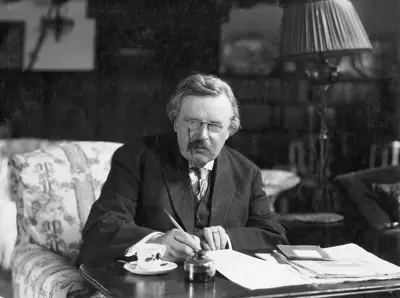
Gilbert Keith Chesterton KC*SG was an English writer, philosopher, lay theologian, and literary and art critic. He has been referred to as the "prince of paradox". Time magazine observed of his writing style: "Whenever possible Chesterton made his points with popular sayings, proverbs, allegories—first carefully turning them inside out."
