Colin Powell Quotes
There are lots of countries that are having these kinds of internal civil wars in other parts of the world and nobody is talking about intervening.
Powell, Colin. Interview on Meet the Press. NBC, 2013.


Paul tended to be one of the very few Republicans who did not favor American intervention in Syria.


The genocide when the Hutu tried to exterminate the Tutsis might have been curtailed with large nation intervention, but that would have interfered in the internal affairs of a sovereign state. Two important principles were in conflict. The rights of the Tutsi minority and the traditional prohibition of interfering in the internal affairs of another country. In this and many situations to follow, ranging from Darfur to Zimbabwe, the realization that the traditional prohibition against internal interference has to trump the most egregious violations of human rights.


His view, that America had no vested interest in Rwanda, was the prevailing thinking of the Republicans who controlled Congress and many of the Democrats as well. President Clinton considered intervention in Rwanda, but decided against it given all the opposition and little time to educate the American public to a different position. The result was the genocide in Rwanda where over 500,000 Tutsis were exterminated by the Hutus. Clinton, several years later not only admitted that he made a political and moral mistake, but officially apologized to Rwandan Tutsis who remained alive. He had intervened very successfully in Kosovo to prevent more murder of ethnic Muslims and was given a hard time politically by his opposition even though the brilliant effort cost no American lives. The United States and the UN, all bearing guilt for doing little in Rwanda, did help to set up the mechanism for the trials of the worst murderers and at least many of the most guilty were brought to justice.


The "trouble" was the terrorist attacks to gain an independent Pakistan that the Punjab Muslims were perpetrating against the Sikhs and the Hindus and the retaliations. At first organized in the cities they had become spontaneous and spread to the countryside. It turned out to be impossible for Governor Jenkins and the limited British troops and police to stop the violence in most places. By the end of the Partition of India hundreds of thousands of Punjabis had been killed.


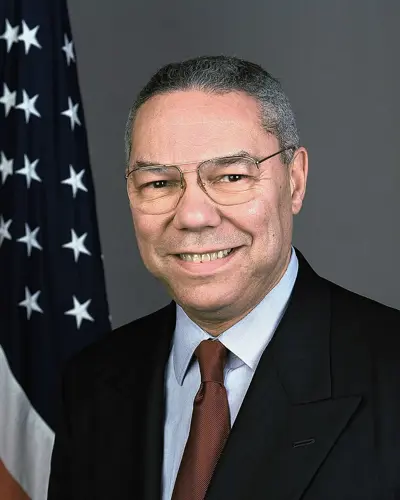
Colin Luther Powell is an American politician, diplomat and retired four-star general who served as the 65th United States Secretary of State from 2001 to 2005. Powell was the first African-American Secretary of State. Prior to the election of Barack Obama as president in 2008, Powell and his successor, Condoleezza Rice, were the highest-ranking African Americans in the history of the federal executive branch (by virtue of the Secretary of State standing fourth in the presidential line of succession). Powell served as the 16th United States National Security Advisor from 1987 to 1989 and as the 12th Chairman of the Joint Chiefs of Staff from 1989 to 1993.
