Albert Einstein Quotes
There are certain restrictive parts of a woman’s constitution that that were given her by nature and which forbid us from applying the same standard of expectation to women as to men.
Although this was written in a 1920 letter, the letter was not publicly published until 1970.
Albert Einstein, 1879-1955, Nobel laureate in Physics, Quoted in Alexander Moszkowski, Conversations with Einstein, 1920, p 79.
Sourced by: Eigen's Political and Historical Quotations

The number of women who studied Physics and sophisticated sciences in Germany at the time were few and far between. Ironically, Einstein married one of the few. However, the marriage failed for many reasons and his subsequent marriage was not to a scientist. Other conversations with him in later years revealed that his belief was that women were constitutionally unsuited to creative, theoretical science—Einstein’s type of science was almost purely abstract and mathematical. See {588596}.

She was writing about the problems that accomplished women face in the then contemporary American society and the choice of wardrobe was one of them.

This 12th century observation which appears so obvious has been ignored by the vast majority of Islamic scholars and writers subsequent until modern times, and even then they represent the small reform minority of Islamic thinking.


He served a jail sentence in Britain for inciting race hatred.


Much of the culture of sexism and racism is perpetuated by language—especially the language of leaders, role, models, and authority figures. “Political correctness” cannot, in a free society, be enforced on anyone. However, making people aware of the implication of certain kinds of language usage is important provided it doesn’t cross the line of curtailing freedom of speech. People who want to perpetuate sexism by their choice of language have the right to do so in America. What is sad, however is the many people who are perpetuating sexism without ever intending to do so. Abdul-Jabbar has been a leader who has made many male sports figures more aware if the implications of their language usage.


She was 1 of the 4 women who entered Oberlin College in 1837 thus becoming the first co-educational institution of higher education in the United States.


This was a quarter of a century before women in the United States could vote.

Mrs. Roosevelt thought that with the rate of improvement in society’s perception and treatment of women was improving so steadily that women in America were not far from equality. Because of the shortage of men on the home front in WWII women had performed well in virtually all occupations including welding, heavy construction and management and it was just a matter of time to reach equality of pay and parity. However, she and most feminists did not take into account the 2 million men returning from military service who wanted their jobs back. Sexists, who had been suppressed during the war when they objected to women in non traditional occupations, were no longer silenced by national necessity. An occupational backlash developed. Then a sexual one regarding contraception and family planning, (Condoms for example were illegal up to 1963 as birth control device). Each major step forward was accompanied by its own backlash and even in the Presidential Campaign of 2012 contained debate on women’s control over their own bodies relative to abortion and contraception.
See {618590} for an example of the kinds of issues which motivated her statement.

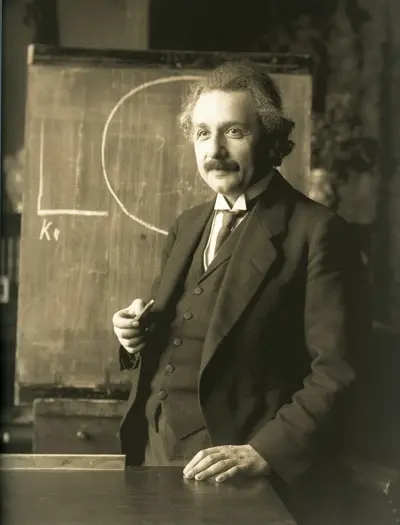
- Born: March 14, 1879
- Died: April 18, 1955
- Nationality: German, Swiss, American
- Profession: Physicist
Albert Einstein was a German-born theoretical physicist, widely acknowledged to be one of the greatest physicists of all time. Einstein is known for developing the theory of relativity, but he also made important contributions to the development of the theory of quantum mechanics. Relativity and quantum mechanics are together the two pillars of modern physics. His mass–energy equivalence formula E = mc2, which arises from relativity theory, has been dubbed "the world's most famous equation". His work is also known for its influence on the philosophy of science. He received the 1921 Nobel Prize in Physics "for his services to theoretical physics, and especially for his discovery of the law of the photoelectric effect", a pivotal step in the development of quantum theory. His intellectual achievements and originality resulted in "Einstein" becoming synonymous with "genius".
