John Calvin Quotes
The world was no doubt made, that it might be a theatre of the divine glory.
Calvin, John. Commentaries on the Epistle of Paul the Apostle to the Hebrews. Translated by John Owen, Calvin Translation Society, 1853, p. 268.


Joseph Alois Ratzinger. His predecessor, John Paul II, had shown no antipathy and had seen no conflict between religion and the concept of evolution. Benedict, was more traditional and particularly sensitive to the randomness of mutations in the process. Other theologians see no contradiction in God having created the evolutionary system with random mutation as the most superior system for developing rational man to whom he gave free will. Others see no need for God in the entire process.

Henry of Navarre. This is one of the first formal diplomatic attempts to create a balance of power. See {622120} for another name for the idea.


His concept of the devine however was quite different and much more abstract than the Rabbis, Priests and Imams of the time. Albert Einstein, was a religious Jew, but his view of God was that of Spinoza (See Quotation 631763) who had been excommunicated by the Jews. Spinoza’s ideas were considered so radical and dangerous that he was the only man in history who was excommunicated by the Catholics, the Jews and the Muslims. Spinoza did not believe in a kins of anthropromorphic God who fabricated the earth and the stars. He saw God in the devine nature of the earth and the heavens and the mathematical rules that govern everything. It was this abstraction that was Spinoza's God which made sense to Einstein. Got was in the order, physical laws and mathematics of the universe. Modern scientists who are religious have no difficulty with the probablsitic nature of much of the physics that governs the univrese. It was God who created or more abstractly, was the mathematical and physical laws that in turn allowed the universe to be created from nothing.


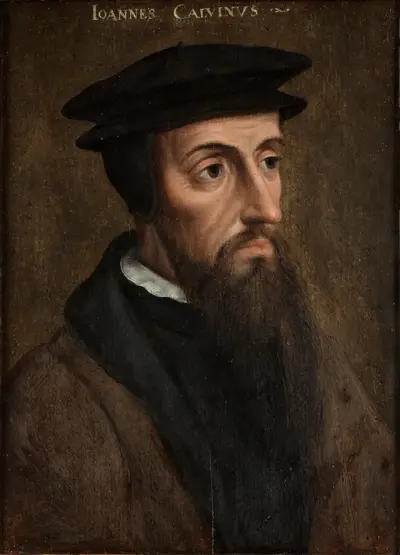
John Calvin was a French theologian, pastor and reformer in Geneva during the Protestant Reformation. He was a principal figure in the development of the system of Christian theology later called Calvinism, aspects of which include the doctrines of predestination and of the absolute sovereignty of God in salvation of the human soul from death and eternal damnation, in which doctrines Calvin was influenced by and elaborated upon the Augustinian and other Christian traditions. Various Congregational, Reformed and Presbyterian churches, which look to Calvin as the chief expositor of their beliefs, have spread throughout the world.
