Marcus Garvey Quotes
The world has made being black a crime .... I hope to make it a virtue.
Marcus Garvey, 1887-1940, Black Nationalist Leader and Founder, Universal Negro Improvement Association
Sourced by: Eigen's Political and Historical Quotations


Qutb was studying at Greeley College and with some Egyptian friends want to a movie theater. Greeley, even though not in the South, practiced racial discrimination in many of their public accommodations and the Civil Rights Law would not be passed for another 15 years or so. The ticked clerk at first would not sell tickets to the dark skinned Egyptians and when one protested, the owner was called. He ruled that as long as they were not American Blacks, they could enter. But Qutb refused.


Ironically Fort-Whiteman was arrested in Moscow in one of Stalin’s massive purges and sent to a Soviet Gulag where he died of starvation. He was one of several Americans who were Stalinist victims. Ironically, he was right about Blacks and revolutionary change, but whereas he thought the “revolution” would be a socialist and communist one, the “Civil Rights Revolution” was a legal, cultural and intellectual one. However, statements like this were taken advantage of by white racists who saw in every attempt to right the wrong of racial discrimination, a communist revolution in the making.

This appears to be the first use of the phrase "Black Power."


Moynihan was actually not the political originator of the "benign neglect" phrase which became so controversial. It had been first used by The Earl of Durham in his 1839 Durham Report on the English policy towards Canada.

Supervisors of black soldiers reminded them that


Blacks were fighting and dying in WWII. They were equal when they were under fire, but otherwise not. The war was against fascist protagonists whose creed was inequality while the allies were upholding freedom and equality. But making that aspiration a reality was difficult.


In the 1930s African Americans who traveled were subject to countless humiliations whenever the sought hotels, rooming houses, restaurants and other accommodations. Gas stations would not allow them to use bathrooms and they were reduced to using open fields. Traveling and vacationing was, for Blacks, humiliating. Wikipedia: “Green reviewed hotels and restaurants that did business with African Americans during the time of Jim Crow laws and racial segregation in the United States. He printed 15,000 copies each year. In the 1930s, Green began his work by compiling data on stores in the New York area that accepted black travelers, and published his first guide in 1936. Similar guides had been published for Jewish travelers, who sometimes faced discrimination. Green's guide was so popular that he immediately began to expand its coverage the next year to other US destinations, adding hotel and restaurants as well.”

Scott was then the Special Advisor on Negro Affairs to the Secretary of War in the Woodrrow Wilson administration. Wilaon hs commited U. S. Troops to fight oversease to "make the world safe for democracy", but many blacks and whites also saw gross hypocricy in asking Negores to fight for a Jim Crow, segregated America. See the related quotation 644805. Scott was also the major aide to Booker T, Washington, one of the leading Negro educators but a very pliable man on equal rights for the Blacks. The problem for the administration was much greater than that of WWII where the president was seen as very sympathetic to Blacks while Wilson was himself a racist. And in WWII the fight against the Nazis was a fight agaisnt racial supremacy. So this quotation and Scott's role was very important to the administration.


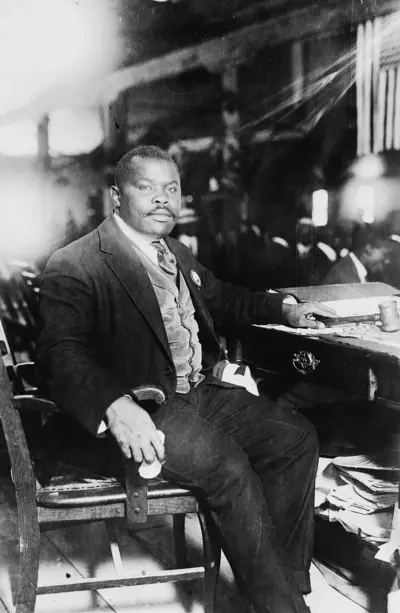
Marcus Mosiah Garvey Sr. ONH was a Jamaican political activist, publisher, journalist, entrepreneur, and orator. He was the founder and first President-General of the Universal Negro Improvement Association and African Communities League (UNIA-ACL, commonly known as UNIA), through which he declared himself Provisional President of Africa. Ideologically a black nationalist and Pan-Africanist, his ideas came to be known as Garveyism.
