Condoleezza Rice Quotes
The U.S. has since the end of World War II had an answer - we stand for free peoples and free markets, we are willing to support and defend them - we will sustain a balance of power that favors freedom.
Rice, Condoleezza. "A Balance of Power that Favors Freedom." Wriston Lecture, Manhattan Institute, 1 Oct. 2002, New York, NY.


At first glance, the reader might think that this quotation in a leading university newspaper was from the Vietnam War era. However, it was argument against U. S. involvement in World War II. There was a very negative reaction to Wilson’s visions and claims for the First World War which never did come to pass that stuck with many.


Russia announced ballistic missile testing in response to NATO announced deployment of a missile shield across Europe. It was the first mini arms race since the fall of the Soviet Union.

In both the First and Second World Wars the Western nations had a multilateral defense pact which did little good in the face of German aggression.

He was referring to the Early Cold War. The American official position and propaganda called for Russian military and political control of Eastern Europe to end and supported uprising and revolution, but the U. S. did not have the power to dislodge Russia without risking a nuclear war.


the modern believe is that democracies are not prone to war, especially against other democracies. Seward, and some others believe that democracies can be pushed into war by politicians you do so for partisan political advantage. Politicians often have to show how tough they are.


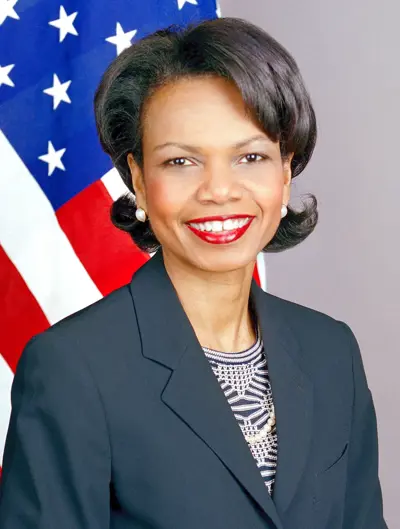
Condoleezza "Condi" Rice is an American diplomat, political scientist, civil servant, and professor who is the current director of the Hoover Institution at Stanford University. Rice served as the 66th United States Secretary of State from 2005 to 2009 and as the 20th United States National Security Advisor from 2001 to 2005. A member of the Republican Party, Rice was the first female African-American secretary of state and the first woman to serve as National Security Advisor. Until the election of Barack Obama as president in 2008, Rice and her predecessor, Colin Powell, were the highest-ranking African Americans in the history of the federal executive branch (by virtue of the secretary of state standing fourth in the presidential line of succession).
