Vincent Bugliosi Quotes
The thing that's most uppermost in my mind and will continue to be until I hit a brick wall is that I am dead serious, dead serious about going after George Bush, trying to get him into an American courtroom and prosecute him for what happened in Iraq.
Bugliosi, Vincent. The Prosecution of George W. Bush for Murder. Vanguard Press, 2008.


This quotation is a good example of how tolerant some nations can be in terms of maintaining diplomatic relations and trade relations with other countries. The American and English governments chose to simply protest and condemn the slanderous statement but decided that the Prime Minister was pandering to his political local Islamic base, so took no further action and kept open diplomatic relations. Mahathir had a history of being very accusatory of the West with respect to anything that affected the Arab Muslims. The number of Muslims killed by the Americans and British in the Iraq War was very small compared to the huge number of Muslims killed by other Muslims in their Sunni Shiite civil war. While Bush and Blair both generated support for the Iraq invasion by making claims of WMD development in Iraq that were false, it is not clear whether or not they knew their statements were false, should have known that they were false, created an atmosphere against Iraq that was likely to produce false accusations, or were simple misled by poor intelligence. Mahathir, of course, chose to assume the worst case, and claim it was true, which is what many people think Bush and Blair did in analyzing the intelligence on Iraq.


Abu Ghraib was the major prison in Iraq during the Iraq War. American military committed many crimes on prisoners ranging from murder to sexual humiliation. The actual perpetrators claimed that the higher ranks of officers knew what was ongoing and provided the policies, rules and culture of the prison. The president and the Vice President many thought were the officers responsible and violated the Uniform Code of Military Justice. Their administration had issued a legal memorandum that for the first time in American history would allow some kinds of torture of prisoners in the War on Terror. A few enlisted personnel were punished and a general was transferred but no senior military or civilian personnel were held responsible or punished.

This is one of the best statements on one of the major reason that terrible leaders stay in power in much of the world but especially Africa. In Uganda, they got rid of the maniacal dictator, Idi Amin, by allowing him to keep some of the money he stole and giving him asylum from world prosecution in Saudi Arabia. It was an unjust and unfair solution as he was never accountable for his crimes against humanity, and he lived well on the money he stole, but thousands of lives were saved and Uganda then was able to grow and develop. It is a Hobsen’s choice for Africa and the World. Both solutions are terrible, and few have ever been able to choose the pragmatic route that was taken in Uganda.

A little over a decade later, it was the conservative President who was condemning Saddam Hussein for gassing his own people and justified the Iraq War in part over that. And in 2007 Saddam having been toppled from power, he was tried for this crimes against humanity with the major charge being his gassing of the Iraqi Kurds. He was hanged for the “liberal hate speech” which had turned into conservative hate speech, but was a correct accusation regardless of which political pole was making it. There were few issues where most Americans were as unanimous as Saddam’s guilt in the gassing of the Kurds with Limbaugh and Saddam’s relatives being about the only people who saw it as propaganda.


South Africa, with the fall of apartheid, instead of arresting, trying, and sentencing the worst of the old regime, elected a truth commission approach instead.

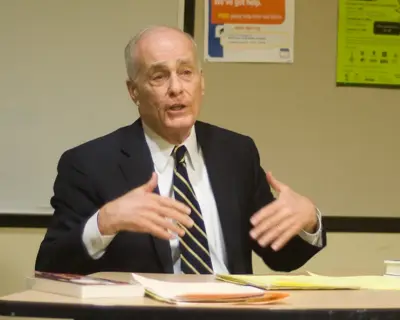
Vincent T. Bugliosi Jr. was an American attorney and New York Times bestselling author. During his eight years in the Los Angeles County District Attorney's Office, he successfully prosecuted 105 out of 106 felony jury trials, which included 21 murder convictions. He was best known for prosecuting Charles Manson and other defendants accused of the Tate–LaBianca murders of August 9–10, 1969.
