Hunter S. Thompson Quotes
The slow-rising central horror of "Watergate" is not that it might grind down to the reluctant impeachment of a vengeful thug of a president whose entire political career has been a monument to the same kind of cheap shots and treachery he finally got nailed for, but that we might somehow fail to learn something from it.
Thompson, Hunter S. The Great Shark Hunt: Strange Tales from a Strange Time. Summit Books, 1979, p. 283.


In England, the King was above the law. However, impeachment was a tool that could be used against his favorite ministers. In debating the United State Constitution one of the first questions to be determined was whether impeachment could be a tool used against the President or like, England, only the other government officials. Franklin urged the President be included. See also Mason: {584246}.


After Truman's firing of General Douglas MacArthur;


When Nixon was running for President in the 1968 Presidential campaign, he learned from Henry Kissinger that the Johnson administration had made an agreement with the Russians and North Vietnamese that America would stop the bombing of North Vietnam if there would be Peace Talks to end the Vietnam War. Nixon feard that although the polls showed him ahead of Vice President Humphrey, the announcement of ongoing peace talks would bring many of the anti-war Democrats who were not supporting Humphrey because of the Vietnam War out to vote for Humphrey to support the Peace Talks. Nixon decided to sabatouge the Peace Talks by persuading Vietnamese President Nguyen Van Thieu not to come to the peace table so there coulod be no talks. He accomplished this by having Anna Chennault, an extreme right-wing fund raiser who was the widow of General Chennault of Glying tiger fame and who had connections with all the right wing politicans in Asia, get word to President Thieu that President Johnson would sell him out in the peace upcomming peace talks, and that if he would boycott the peace talks till after the American Presidential election, Nixon as the New President would be sure that Thieu would remain in control of South Vietnam or there would be no peace and America would continue the war until the North Vienamese would agree to a peace that kept Thieu in power. Earlier, Nixon had appointed Anna Chennault as the Offical Spokesperson of the Campaign on Asia. What Nixon did was a felony--private citizens are not alowed to intere with government negotiatons or discussions with foreign governments under the Logan Act. Many think that the action was legally Treason. Hoever, Nguyen VanThieu did boycott the peace talks despite all the entreaties of President Johnson and his administration. There were no peace talks and the public never even knew that there had been this attempt. The anti-Vietnam War voters mostly did not vote and Nixon won a close race. Shortly after the election, before Nixon could be sworn in, via the FBI, Johnson learned of Chennault's activities but thee was no evidence to tie Nixon to the South Vietnam refusal to come to the peace table. It never became a public issue although several leading politicians had learned what had really occured--see Quotation 664238. However, 0ver 40 years later, when Nizon's Chief of Staff's notes were finally made public, the smoking gun was dislosed and Farrell wrote this in his 2017 Biography of Richard Nixon. See Related Quotes for quotations from H. R. Haldman's hadnwritten notes of his phone call with Nixon, and other evidence that had also been uncovered.


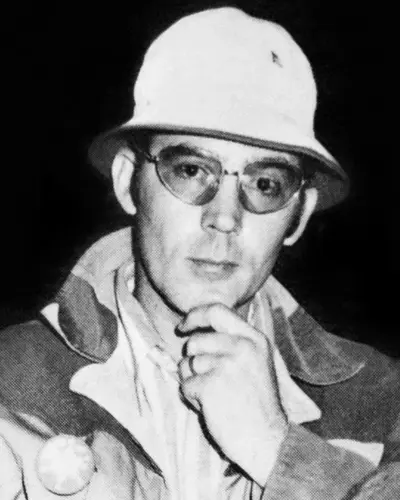
Hunter Stockton Thompson was an American journalist and author, and the founder of the gonzo journalism movement. He first rose to prominence with the publication of Hell's Angels (1967), a book for which he spent a year living and riding with the Hells Angels motorcycle club to write a first-hand account of the lives and experiences of its members.
