Robert M. La Follette Quotes
The right to control their own government according to constitutional forms is not one of the rights that the citizens of this country are called upon to surrender in time of war.
Robert M. La Follette, 1855-1925, Governor of Wisconsin (Republican), U.S. Senator (Republican, WI), Presidential Candidate (Progressive), Senate speech, October 6, 1917
Sourced by: Eigen's Political and Historical Quotations

It is ironic that Pakistan, the creation of Jinnah’s efforts, has to a great extent adopted Sharia (Islamic Law) resulting in severe curtailment of freedom of speech and thought. Professors languish in jail for not teaching the history of Muhammed in the orthodox way, people are sentenced to death for what the local mullahs regard as blasphemy—results which from Jinnah’s point of view were terrible.

He had been a Congressman before assuming the Presidency. Civil rights was a major subject of debate after the Civil War. One major issue was that of citizenship itself. Many contended that Americans were citizens of a state and dependant on the state for the protection of civil rights. However, the extent to which the Federal government could and should be the guarantor of citizenship issues was in dispute. Today with the issue settled in favor of Federal preeminence, it is hard to realize that this was very unsettled at one point in history. Garfield was one of those leading the effort for more Federal involvement and control.


The call for individual liberty and the right of personal property by clergy is surprising to many. This Cahier was the consensus of the Clergy of Blois in 1789. There were cahiers of several provinces of France—some by the clergy, some by the nobles. What is fascinating is the emergence of many of the pre-Revolutionary French concepts. The example of the American revolution and its principles was known throughout the educated classes of France.


In WWI Congress had passed a law that prohibited anyone from undermining or interfering with the war effort. The defendants had passed out anti-war literature to young men heading for military service. The court then overlooked the First Amendment and came up with a strange logic where the “clear and present danger” was the test of whether the First Amendment would apply. The anti war pamphleteers went to jail. Today, we look back on this and find it very surprising but this is yet another example of erosion of freedom and civil liberties when the nation is at war. By the 1950s, the Supreme Court had reversed itself and the First Amendment was restored to its original intent.

Many New Yorkers and others felt that since the attack on the World Trade Center was made in the name of Islam, the mosque and commuity center should be built in another location further from Ground Zero. Ellison was debating someone who argued that the Mosque should not be built so that sensitivity can be shown for those New Yorkers who lost relatives and friends in the attack of September 11. Rather than insist on their Constitutional rights, the Muslim leadership of the project, moved the location somewhat further away from Ground Zero.


This quotation was used ten years later by Virginia which, in convention, passed a resolution objecting to the Alien & Sedition Acts. The drafter of the original resolution was James Madison.
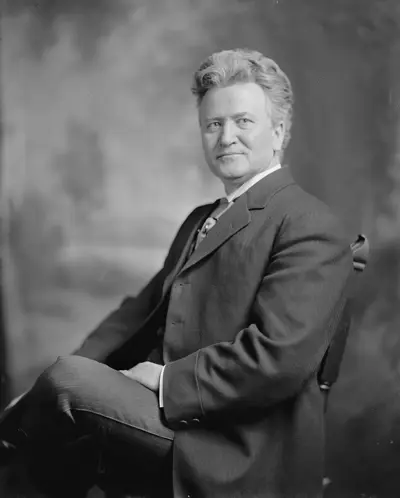
Robert Marion "Fighting Bob" La Follette Sr., was an American lawyer and politician. He represented Wisconsin in both chambers of Congress and served as the Governor of Wisconsin. A Republican for most of his career, he ran for President of the United States as the nominee of his own Progressive Party in the 1924 presidential election. Historian John D. Buenker describes La Follette as "the most celebrated figure in Wisconsin history."
