Paul Krugman Quotes
The raw fact is that every successful example of economic development this past century—every case of a poor nation that worked its way up to a more or less decent, or at least dramatically better, standard of living—has taken place via globalization; that is, by producing for the world market rather than trying for self-sufficiency.
Paul Krugman, Economist & Political Columnist, Nobel Laureate in Economics, Column, Slate, November 23, 1999
Sourced by: Eigen's Political and Historical Quotations


This was an incredible prediction that few people thought was possible. This speech was given in the early days of WWII when it was far from clear that we would win.


Although the Premier recognizes the importance of environmental protection it is difficult for China and other developing countries to make the necessary trade off’s at the expense of slower growth which means continued poverty. Even in the United States with all its affluence, slowing economic growth for environmental reasons is politically very difficult.


Zhou , Deng and other Chinese senior leaders carefully studied failures of 200th Century Communist nation economies from Russia to North Korea, and observed the successes of not only the United States and Western Europe, but South= Korea and Thailand å well and decided to transform to a capitalist style market and competitive economy. Zhou organized a cruse on which they invited Western economists and political economists to advise on how to make the transformation. Th Chinese took many of the Western ideas, placed them into a Chinese context, added some ideas of their own and proceeded ahead with the largest and most seectaculkar economic transformation and development in World history.


The relationship of population increase economic growth is a critical one. If an underdeveloped country manages to have a 3% annual economic growth rate and also has a 3.2% population growth, at the end of the year, the average person is actually poorer than he was the previous year. South Korea, China, Thailand and India implemented successful population control and family planning programs before they were able to take advantage of economic development. To modernize, the country must be able to have a surplus of funds which can be invested in roads, schools, hospitals, and other facilities which can produce even more growth later. Too many new mouths to feed, clothe and care for can be a barrier to development even if the economy is reasonably good.


The nation, under the pressure of a depression, had adopted a free trade philosophy. We would go back to protectionism in the 1930s and back to free trade in the 1960s. Ironically, it was generally the Republican party that has driven these shifts. There has always been a free trade wing of the party and an isolationist wing.

Historicaly this quotation gives us an idea of how backward the Arab countries were. And at that time, Egypt was the biggest and most advanced in the Middle East.


Large financial companies insist on profits at regular intervals and predictability whereas the innovative companies do not do well trying to meet those conditions and spending their time with the large finance company. While large financial companies were important to finance companies on the latter part of the 20th century, it was the smaller finance companies who financed most of the very important start-ups. By the 21st century, companies like Google and Facebook, made their own public stock offerings bypassing the financial industry. Many other smaller companies were financed via crowd sourcing which also bypasses the financial industry. His point is that the large successful companies can get the funds the need for growth without large finance companies. Smaller firms and startups can (and do) obtain funds through small finance firms or direct private investment. The large finance companies not only inhibit innovative growth he warns but they become such a dominant and controlling force that the industry becomes too big to fail, and the failure of a single large finance company could destroy the entire country’s economy. It happened to Island when their largest bank failed, and to the United States in the Meltdown of 2008.
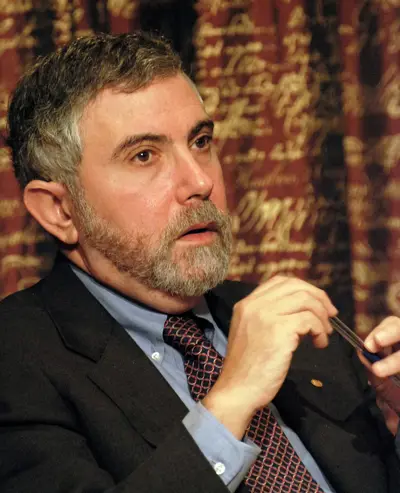
Paul Robin Krugman is an American economist who is the Distinguished Professor of Economics at the Graduate Center of the City University of New York, and a columnist for The New York Times. In 2008, Krugman was awarded the Nobel Memorial Prize in Economic Sciences for his contributions to New Trade Theory and New Economic Geography. The Prize Committee cited Krugman's work explaining the patterns of international trade and the geographic distribution of economic activity, by examining the effects of economies of scale and of consumer preferences for diverse goods and services.
