Marine Le Pen Quotes
The problem is that it’s not a bathing suit, It’s an islamist uniform. It’s one of the ways in which Islamic fundamentalism flexes its muscles.
She was referring ti burkinis—Muslim beachwear that voce red all of a woman’s body and hair. She was one of the supporters of a ban on the wearing of burins on French breaches.
Marine Le Pen Interview Foreign Affairs. November/December 2016 Volume 95, Number 6
Sourced by: Eigen's Political and Historical Quotations

At the time she made this statement, she was the French Minister of Families, Infants and Women;s Rights. France was in the midst of a political and legal argument over the right of communities to ban women at the beaches to wear burkina’s. These were garments that covered the woman’s body completely that some French Muslim leaders claimed was the only mortal way a Muslim woman could go to a beach. Secularists divided into two groups. Those who argued that the right of dress or undress for a French woman was inviolable by the state. The otters groups argued that the burkini was clear method of control of women by men which is so contrary to French rights and mores, that the community should be allowed to be practiced. The Minister was with the latter group.


The writer was born and brought up a Muslim and because he criticizes Islam, he has had a death fatwa issued against him much like Salman Rushdie. His prediction was one of the earliest warnings


From the latter part of the 20th century onward, religious nationalism was no longer a force for most religions and nations except Muslim countries. It was the only religion left where a large proportion of the adherents saw no distinction between the religion and the government. Nations that had separation of church and state were not conducive to the extreme fundamentalist form of Islam where the Secular Leader and the Religious leader was to be embodied as a single person. As a result Islamic religious nationalists argued for a Theocracy and at times fought for it with violent means. The secular government typically, to curtail the violence and prevent a religious takeover, often outlawed the extreme religious Islamic parties. While Aslan cites the Muslim Brotherhood failure in Egypt as a desirable outcome, the only way the other forces of Egyptian society could prevent the Islamists from taking over turning the country into a theocracy was to forcefully repress the extremists. The Turkish outcome was much better, but there was the threat of repression of the Justice and Development Party when it won a majority control of the government. There were explicit threats that if it tried to weaken the secular nature of the government as Ataturk had formulated it, the military would come “out of the barracks” and oust the government as they had done before. There were nations like China which persecuted religions such as certain forms of Christianity, but those religions were not fighting for religious nationalism. They only wished the freedom to practice their religion and had no program or theology that argued for Christianizing the government. The Tamil Hindus of Sri Lanka did not want a Hindu government and were perfectly free to practice their religion. The problem was that they felt that there was systemic social and economic discrimination against the Tamils and they fought for independence—not of a Hindu state, but of a secular, nondiscriminatory state of equal opportunity.

This was another historical reality that shocked traditionalists. There was nothing in the Koran or Islamic scripture requiring women to wear veils and burkas. Many Muslims and non-Muslims, to this day, do not realize that.


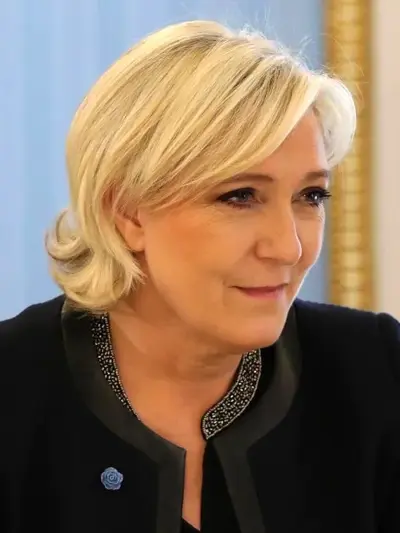
Marion Anne Perrine "Marine" Le Pen is a French politician and lawyer who has been President of the National Rally (previously the National Front) since 2011. She has been the member of the National Assembly for the 11th constituency of Pas-de-Calais since 2017.
