Karl Marx Quotes
The more the division of labor and the application of machinery extend, the more does competition extend among the workers, the more do their wages shrink together.
Marx, Karl. Wage-Labor and Capital. Translated by Harriet E. Lothrop, New York Labor News Company, 1902, p. 54.


The nation was divided over the issue of immigration. Many observed that the vast majority of the immigrants—especially the illegal immigrants performed jobs for which American workers could not be hired. Opponents like the congressman, claimed that if better wages were paid Americans would be doing the jobs, and as long as there were immigrants who would work for low wages, there was little reason for employers to pay more.


There were by then few jobs left in the American economy that did not require fundamental literacy and most required post secondary education as well.


Well over a century ago, this prescient economist pointed out that in a very competitive economy, people would have to develop and have multiple skills to remain employable. The competition also produces technological obsolescence.


One problem critics have with his argument is that while there is always work to be done, there are not always entities willing to pay for the additional work. Gains in productivity will justify investment in more rapid deployment of technology; thus entities in society are will to invest the funds. But if there is no visible economic return from the additional work, corporations and taxpayers may be unwilling to fund it leading to massive unemployment and instability.


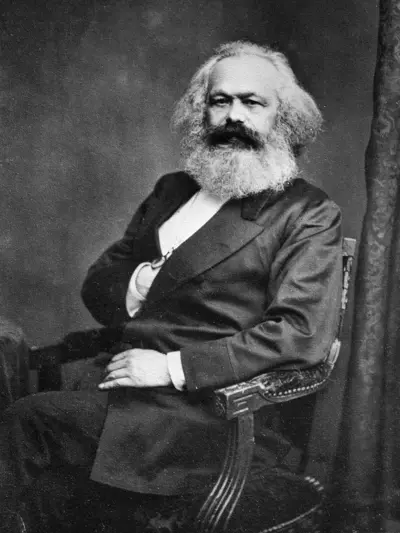
Karl Heinrich Marx was a German philosopher, economist, historian, sociologist, political theorist, journalist and socialist revolutionary. Born in Trier, Germany, Marx studied law and philosophy at university. He married Jenny von Westphalen in 1843. Due to his political publications, Marx became stateless and lived in exile with his wife and children in London for decades, where he continued to develop his thought in collaboration with German thinker Friedrich Engels and publish his writings, researching in the reading room of the British Museum. His best-known titles are the 1848 pamphlet The Communist Manifesto and the three-volume Das Kapital (1867–1883). Marx's political and philosophical thought had enormous influence on subsequent intellectual, economic and political history. His name has been used as an adjective, a noun, and a school of social theory.
