Henry David Thoreau Quotes
The majority of the men of the North, and of the South and East and West, are not men of principle. If they vote, they do not sendmen to Congress on errands of humanity; but while their brothers and sisters are being scourged and hung for loving liberty,... it is the mismanagement of wood and iron and stone and gold which concerns them.
Thoreau, Henry David. "Slavery in Massachusetts." The Liberator, 21 July 1854.


This moral statement from a New jersey Quaker abolitionist is not particularly noteworthy, However what makes this quote important is that Woolman traveled throughout the South preaching this as his main theme. At that time — before the American Revolution — he did so and was not attacked or intimidated; he was mostly ignored by the Southern authorities. At the time, the South was very confident of its ability to continue slavery. Years later, when the abolition movement grew larger and stronger, a Northern Quaker Preacher doing this not not escape with his life.


After Adams’ term as President, he was elected to the House of Representatives where he served for the rest of his career. He was constantly calling for the emancipation of slaves (see {77463}) in the House debates. The Southern Congressmen were so offended by this that they got the majority of the House to pass a rule that made using the word “slavery” out of order. It was called the “Gag Rule”. Adams, one of the best legislators and lawyers of his day, then started reading in the House debates petitions of his constituents calling for an end to slavery. The Southerners called for the Speaker to declare him out of order for violating the gag rule. But Adams pointed out that the Constitution gave citizens the right to petition Congress with no controls on the petitions. Therefore the reading of the petitions was Constitutionally mandated and trumped the Rules of the House. He then arranged to have many petitions submitted which he dutifully read on the House floor to the extreme anger of the Southerners.

As an entertainer she had toured much of the world and seen American slavery and that of some other nations. She became a staunch abolitionist and like entertainers in the 20th and 21st centuries she used her celebrity to give anti-slavery lectures and perform for audiences where she donated the proceeds of the event to the abolition cause. She is a particularly interesting political figure in that she seems to be one of the first entertainers to perform for a social cause and become an activist.

Even before we had a Constitution there was major opposition to slavery. The “price” of the American Union was the acceptance of the slavery of the South. But the hypocrisy of a country based on liberty to allow and enforce slavery was not lost on the founding fathers. Ironically the abolitionists among the founding fathers were certain that they could persuade the Southern slaveholders of the error of slavery in a few years and things would be set right in the land. Even George Washington {630626}, and Thomas Jefferson and some other slaveowners at the time wished to see its abolition. Slaveholding Southern Founding Fathers in general were so wary of the abolitionists that they achieved structural, disproportionate, power in the new Constitution to ward off the abolitionists attempts to reform slavery.

Although Wedgwood was a business man and ceramic manufacturer, he was a staunch abolitionist. He made these medallions by the thousands and gave them to all who would receive them. The text became the motto of the anti-slavery society. It was one of the first examples of a logo – a symbol for a political cause being very effective.

The political conflict between the right of the slave to liberty and the right of the slave owner to his property made the immediate abolition of slavery very difficult after the Spanish had been overthrown in South America.


The country had been completely polarized by 1854. It was only a matter of time for something like the Civil War to break out. The impossibility of compromise was not just held by radicals like Garrison but after the Compromise of 1850 fell apart, most politicians on both sides s

Southerners from the slave states wanted California to be admitted to the Union as a slave state. But a large majority of Californians saw that as a terrible alternative. It was argued that the Southern states would never vote to admit California if it were a free state (see {613404}) and in order to make it clear to the South that admission as a slave state was out of the question, this clause was passed at the Constitutional Convention.

The issue of slavery which had been suppressed in Congress for the first decades of the nation broke out when Missouri statehood was considered. By previous agreement, slavery was not even discussed in Congress but the time period elapsed. Tallmadge not only proposed that no more slaves could come into Missouri {613176} but most shocking to the Southerners was that every person born in the new state would be free at the age of 25. In a generation, there would be no more slavery in Missouri and there would be no economic compensation for slave owners at all. The House of Representatives accepted the amendment, but it failed in the Senate. At that time, Senators were not elected by voters but were appointed by the state legislators and the Southern slave states had a disproportionate share of the senate from a population point of view. But what this quotation shows clearly that a majority of the country in 1819 were opposed to slavery and were willing to end it without compensation.
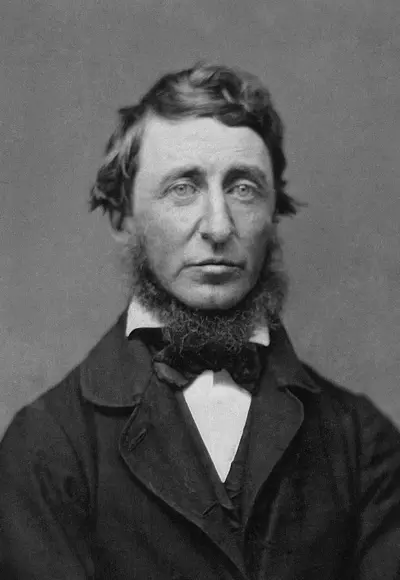
Henry David Thoreau was an American naturalist, essayist, poet, and philosopher. A leading transcendentalist, he is best known for his book Walden, a reflection upon simple living in natural surroundings, and his essay "Civil Disobedience" (originally published as "Resistance to Civil Government"), an argument for disobedience to an unjust state.
