William Blackstone Quotes
The liberty of the press is indeed essential to the nature of a free state: but this consists in laying no previous restraints upon publications, and not in freedom from censure for criminal matter when published. Every freeman has an undoubted right to lay what sentiments he pleases before the public: to forbid this, is to destroy the freedom of the press: but if he publishes what is improper, mischievous, or illegal, he must take the consequence of his own temerity.
Blackstone, William. Commentaries on the Laws of England. Vol. 4, Clarendon Press, 1769, pp. 151-152.


The evils of the time were even worse than in modern times. Most newspapers, journals, and periodicals were in 1835 actually owned and operated by political parties or people totally identified with political parties. In modern times, there are publications and blogs which are controlled by political forces, but most are not.


Jefferson was visited by a famous German scientist who read a newspaper in the President's study which viciously attacked Jefferson. The scientist asked why this was allowed in America:

Two decades later Jefferson, after his Presidency, had developed a different attitude towards the press. See {585116}.


This language is from the earlier version of the Constitution passed in the middle of the 19th century.

Twenty year prison sentences were imposed for publishing left wing Bolshevik literature. The case was appealed to the Supreme Court:

Note how the second paragraph nullifies the first of the government declares an emergency. This is a trick that is very common in constitutions.


Originally it was published in Boston under the name “A Columbian Patriot.” This was written before the Bill of Rights had been added. Criticism like this led to their addition by Congress in order to obtain ratification.

Arguing against explicit guarantees of press freedom in the Constitution Hamilton felt that the freedom could be maintained by public opinion and the good will of government:


Virginia had adopted this right almost 20 years before it was added in the Bill of Rights to our Federal Constitution. Mason had drafted it.


The President was reacting to a chain of vents whereby Sony Entertainment produced a satiric movie which offended the leadership of North Korea who condemned, threatened and may have launched a cyberattack on Sony. That company reacted by withdrawing the movie and the President thought that was a mistake despite the fact that there were threats against theaters showing the movie and people attending the showings.


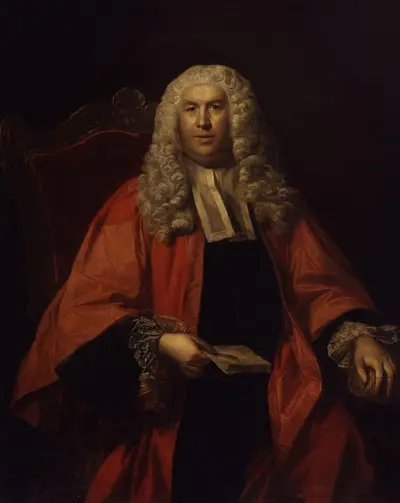
Sir William Blackstone SL KC was an English jurist, judge and Tory politician of the eighteenth century. He is most noted for writing the Commentaries on the Laws of England. Born into a middle-class family in London, Blackstone was educated at Charterhouse School before matriculating at Pembroke College, Oxford, in 1738. After switching to and completing a Bachelor of Civil Law degree, he was made a fellow of All Souls, Oxford, on 2 November 1743, admitted to Middle Temple, and called to the Bar there in 1746. Following a slow start to his career as a barrister, Blackstone became heavily involved in university administration, becoming accountant, treasurer and bursar on 28 November 1746 and Senior Bursar in 1750. Blackstone is considered responsible for completing the Codrington Library and Warton Building, and simplifying the complex accounting system used by the college. On 3 July 1753 he formally gave up his practice as a barrister and instead embarked on a series of lectures on English law, the first of their kind. These were massively successful, earning him a total of £453 (£71,000 in 2021 terms), and led to the publication of An Analysis of the Laws of England in 1756, which repeatedly sold out and was used to preface his later works.
