Frederick Sleigh Roberts Quotes
The less the Afghans see of us the less they will dislike us.
His advice and conclusion about Afghanistan was not taken by the British of any of the other military forces that have been in Afghanistan including the Russians and the American-led coalition in the early 21st century.
Frederick Sleigh Roberts, 1832–1914, 1st Earl Roberts, British General & Field Marshall, Commander-in-Chief of the British Forces, Comment about the British Military Presence in Afghanistan, 1880
Sourced by: Eigen's Political and Historical Quotations


Article 9 of the 1946 Japanese constitution that was imposed on Japan {604739} severely limited Japan’s military. Emperor Hirohito asked privately how Japan would be protected.

The inconsistency of the policy logic of attacking Iraq but not the other two countries of the "axis of evil" caused problems for our British allies who preferred justifying the attack on Iraq on its own merit without any linkage to Iran and North Korea. What made the Iraq invasion even more puzzling was that both Iran and North Korea were greater dangers to the United States and expressed a deep animus.


Russia announced ballistic missile testing in response to NATO announced deployment of a missile shield across Europe. It was the first mini arms race since the fall of the Soviet Union.


The Russian motivation for going to the aid of Serbia when the Austro-Hungarian Empire attacked that country was religious affinity. Both were of the Orthodox Church and the Orthodox Slaves had historically been attacked by the Roman Catholic Teutons. Russia had exercised hegemony over regions outside of Russia where there were Christian Orthodox co-religiouists.

3rd Earl Russell of Kingston. The military weak nations agreed with him, but the militarily strong ones did not—especially America and England which had the Atomic Bomb when others did not.

Despite the fact that there were no formal political polls at the time, public opinion was very influential in curtailing what might be a tendency to use of the American military. Starting with the Cold War later, Presidents tended to use American military force regardless of public opinion or would exaggerate or lie (Vietnam and Iraq wars for example) to temporally gain some public support.

At first reading, this quotation appears to have been made in 2013 with respect to the American-led Coalition in the Afghan War in 2013. But this was 133 years earlier. Little had changed.

The Russians, who had invaded Afghanistan successfully, then proceeded to lose Afghanistan.

Most American felt that way at the time of the Russian occupation and the Mujahedeen resistance.


Dreadnoughts were huge battleships. Britain had the dominant navy of the world and controlled the seas. A European war would be a land war where a navy would be of little use. Hence, Britain would not want to get involved in such a war where she could not use her greatest military strength. He was wrong about this and so much else. Britain entered WWI when Germany invaded Belgium fulfilling her treaty obligations. The Germans intelligence operators and analysts were well aware of the treaty obligations, but had little understanding of English culture and tradition. The German aggression against a small power like Belgium was morally offensive to many in Great Britain, and Britain had a tradition of fighting for moral principles. The Germans would never militarily disadvantage themselves for the sake of a treaty obligation to a small nation, and they did not believe that the British would be so different and fulfill their treaty obligations even though their strongest military asset—their navy would not be very helpful.


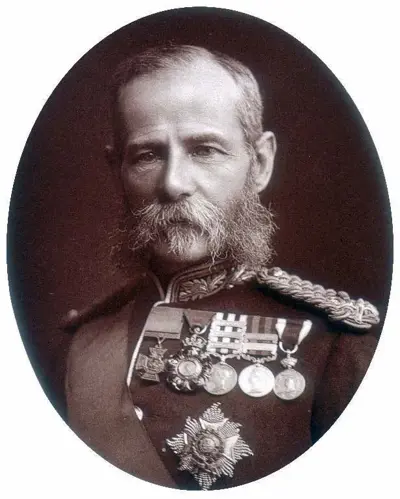
Field Marshal Frederick Sleigh Roberts, 1st Earl Roberts, VC, KG, KP, GCB, OM, GCSI, GCIE, KStJ, VD, PC, FRSGS, was a British Victorian era general who became one of the most successful British military commanders of his time. Born in India to an Anglo-Irish family, Roberts joined the East India Company Army and served as a young officer in the Indian Rebellion during which he won a Victoria Cross for gallantry. He was then transferred to the British Army and fought in the Expedition to Abyssinia and the Second Anglo-Afghan War, in which his exploits earned him widespread fame. Roberts would go on to serve as the Commander-in-Chief, India before leading British Forces to success in the Second Boer War. He also became the last Commander-in-Chief of the Forces before the post was abolished in 1904.
