Friedrich Nietzsche Quotes
The governments of the great States have two instruments for keeping the people dependent, in fear and obedience: a coarser, the army; and a more refined, the school.
Nietzsche, Friedrich. Human, All Too Human. Translated by R. J. Hollingdale, Cambridge University Press, 1996, p. 381.

Slavery was Hammond’s pet example where the Federal Government was constantly trying to limit, and control the South. However, he and later anarchists many libertarians of this day see the issue as a general principle.


England did not follow this precept but the United States did and is the only country that did. In all others, education is controlled by the national government. However, Godwin's principle of separating education from government is not maintained in all the states of America. In many, the State government leaves much of the curriculum and the operations of the school to local school boards which have a great deal of discretion. However, in most of the Southern States, the State government dominates and controls education and relatively little is left to the school boards. In some the State chooses the allowable textbooks. In those cases, Godwin's principle is violated, but in most of the North East and Midwest and some of the far West the school boards have great autonomy and Goodwin's principle is upheld. It is fascinating that the more control a particular state exercises of the schools, the poorer the performance of the schools of that state. Goodwin had a terrific insight.


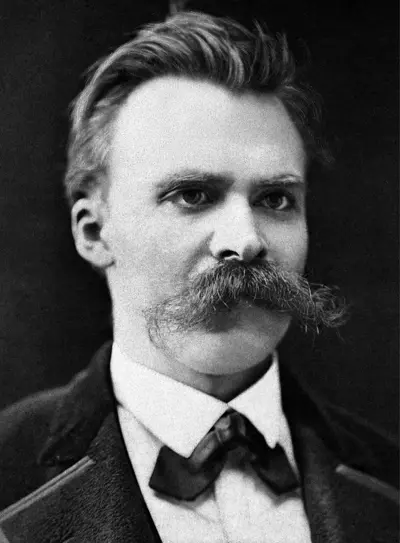
Friedrich Wilhelm Nietzsche was a German philosopher, cultural critic, composer, poet, writer, and philologist whose work has exerted a profound influence on modern intellectual history. He began his career as a classical philologist before turning to philosophy. He became the youngest person ever to hold the Chair of Classical Philology at the University of Basel in 1869 at the age of 24. Nietzsche resigned in 1879 due to health problems that plagued him most of his life; he completed much of his core writing in the following decade. In 1889, at age 44, he suffered a collapse and afterward a complete loss of his mental faculties. He lived his remaining years in the care of his mother until her death in 1897 and then with his sister Elisabeth Förster-Nietzsche. Nietzsche died in 1900.
