Francis Fukuyama Quotes
The financial rewards of economic change have accrued disproportionately to the most talented and well-educated members of society.
Francis Fukuyama, Political Scientists, “The Future of History”, Foreign Affairs, January / February 2012
Sourced by: Eigen's Political and Historical Quotations


The same greatest issue was still before the people a century later. See {633217} , {635104} & {630538}.


The “competition of the poor included the political and social activism competition.”

The debate over income inequality generally ranges between the two extremes of Christie’s hypothetical equal, mediocre salary to the extreme wealth of the 1% controlling most of the wealth. However , where America was moving in its most general affluent times was not towards equal compensation, but to a large range of remuneration with the low end and middle constantly increasing over time and the high end a reasonable multiple of the low end. However, the breakdown came in the last decades of the 20th century and the early 21st century when the low end did not increase (discounting for inflation) in 40 years, nor did the middle, while the high end increased enormously. So the nation had 40 years of growth without the lower or middle classes benefitting much and all the benefit going to the wealthy and most of that to the very wealthy. Thus the instinct was to tax the wealthy more heavily and spending the money to increase opportunity for the lower and middle classes. However, the political battle was waged over the taxing issue and not on what could be done to have the poor and the middle class obtain a larger proportion of the growth and a smaller percentage of the setbacks.


The crisis of inequality of income and wealth has occurred seven times in American history.


See {34743} or {33971} for a more colorful and eloquent statement of the same notion.


This was one of his great fundamental questions of mankind which his research began to answer.
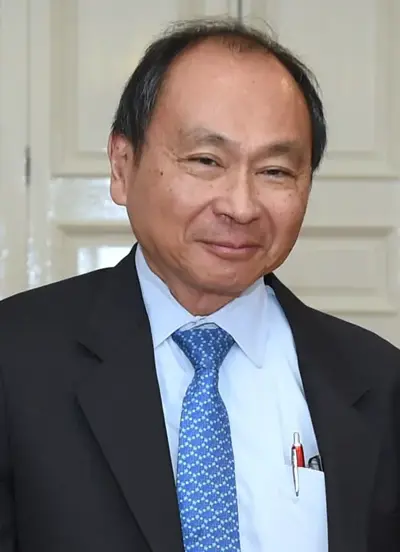
Yoshihiro Francis Fukuyama is an American political scientist, political economist, and writer. Fukuyama is known for his book The End of History and the Last Man (1992), which argues that the worldwide spread of liberal democracies and free-market capitalism of the West and its lifestyle may signal the end point of humanity's sociocultural evolution and become the final form of human government. However, his subsequent book Trust: Social Virtues and Creation of Prosperity (1995) modified his earlier position to acknowledge that culture cannot be cleanly separated from economics. Fukuyama is also associated with the rise of the neoconservative movement, from which he has since distanced himself.
