Daniel H. Hill Quotes
The field of battle at Buena Vista is 6½ miles from Saltillo. Two Indiana volunteers ran away from the field of battle at the same time; one ran half a mile per hour faster than the other, and reached Saltillo 5 minutes and 54 6/11 seconds sooner than the other. Required their respective rates of travel. At the Women's Rights Convention, held at Syracuse, New York, composed of 150 delegates, the old maids, childless-wives, and bedlamites were to each other as the number 5, 7, and 3. How many were there of each class?
D. H. Hill. These are very important historical quotations in that they illustrate something that is not well known by most of us. In the decades before the Civil War there was a strong cultural enmity on the part of most Southerners of the Northern countrymen. It was so gross and overt that problems like this in a Southern college Algebra Text were not only published but used un schools throughout the South. Northerners were depicted in many of the Southern Cultural examples as duplicitous, greedy, dishonorable, cowardly, radical, irreligious, and extremist. The North did not have a very favorable view of Southerners who were perceived as uneducated, reactionary, anti-modern, lazy, hypocritical, cruel and backward – much implied by the acceptance of slavery. However the Northerners were not overt about their biases. These kinds of derogatory school problems were not acceptable. However the Northern bias was in some ways worse as it made most Northerners quite condescending when interacting with Southerners. After the Civil War, Southern education, culture, science and industry did not develop at the same pace as the North and the condescension continued well into the 20th century, at the end of which the South began to close the historical gap.
Daniel Harvey Hill, 1821–1889, Southern Mathematics Professor, Civil War Confederate General, Problems in Southern Algebra Textbook, Elements of Algebra, 1849
Sourced by: Eigen's Political and Historical Quotations

This quotation is historically very interesting. Southern educational materials were extremely scarce with paper one of the commodities most in short supply as the only book paper in the South came from England and had to be smuggled through the Union blockade. Yet the priority was so high that paper was made available in the midst of the Civil War. Confederate civilian morale was a very serious problem while at the same time large numbers of Southern civilians and military were delusional about the Confederate fighting capability. Central to that theme was the myth that the Southern soldier, fighting for such a righteous cause, was several times more effective than his Yankee counterpart. Therefore, the fact that the South was outmanned, out gunned, and out supplied, did not imply a Union victory. So teaching this to the young Southern children who would spread it to the adults on the home front, was a conscious Confederate propaganda effort at this time. Also, the use of these kinds of death and killing arithmetic problems for young children, while considered patriotic in the South was thought to be gross, crude, uncivilized and unchristian by most in the North. The implied 90 to 1 superiority ratio was laughed at in the North, but actually believed by a substantial number of Southerners.


This quotation illustrates not only the virulent racism of some people of the era, but General Walker had been the commander of the Federal Troops that President Eisenhower had to depend upon in the Little Rock desegregation law enforcement. Radical segregationists held key positions at the time in the military and FBI. When it came to segregation, many of the Federal officials sworn to uphold the law, thought desegregation wrong and positively evil as Walker did, and opposed or undermined the law.

The teaching of hatred towards other people—especially people of a different religion has a long and tragic history. The Palestinians and other Muslims did not invent or even perfect the technique which was ongoing before Islam began and reached a low point in WWII Nazi Germany. But in the modern world, most other religions and people have put a stop to the overt teaching of hatred. The Muslims alone invest large resources towards teaching hate of Americans, The West, Jews, Israel


Fitzhugh was a Southern iconoclast whose view of Northern labor was much like that of Karl Marx but who was an enthusiastic supporter of slavery.

This quotation from one of America’s great historians illustrates the cultural divide that existed between the North and South just prior to the Civil War. While it was true that the quality of education in the South was far inferior to that of the North (a disparity that would take almost 150 years to dissipate), there was a snobbishness and social intolerance that existed and persisted into the 21st Millennium. It was virtually impossible to debate the slavery issue between Northerners and Southerners as the two did not even recognize the same kind of logic and analytic methods.


The Kansas City Public Libraryhad been vandalized in the wake of the Donald Trump victory in the 2016 Presidntial race. Almost all of the racist, white supremicist, and Nazi organizations and their members were Trump supporters although Mr. Trump denied that he had ever overtly solicited their support, However hia frequent racist and misoginistic remarks attracted frings groups and people who had never before endorsed an American major party Presidential candidate. After Trups victory there was a large increase in the nunber of racist, religious and ethnic attacks against people and property, despite the fact that Trump had appeared on 60 Minutes and told these extremsits in no uncertain terms to "Stop". Neo Nazis and other White Supremecists generally do not with shows like 60 minutres however, and Trump and his staff made little effor to communicate Trums message through the vehicles that they communicagte through.
The letter was also published in the Charleston Mercury, February 13, 1861


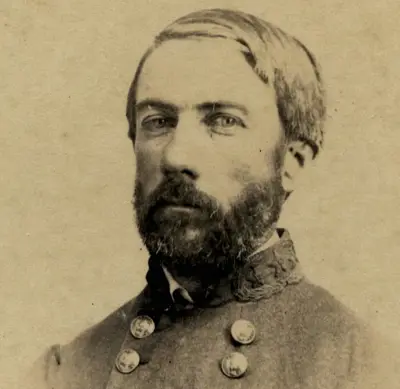
Daniel Harvey Hill was a Confederate general during the American Civil War and a Southern scholar. He is usually referred to as D. H. Hill, in part to distinguish him from unrelated Confederate general A. P. Hill, who served with him in the Army of Northern Virginia.
