Hiram Rhodes Revels Quotes
The colored race saved to the noble women of New England and the middle States men on whom they lean today for security and safety. Many of my race, the representatives of these men on the field of battle, sleep in the countless graves of the South.
United States, Congress, Senate. Congressional Globe. 41st Congress, 2nd Session, Office of the Congressional Globe, 1870, p. 1987.


This line was used in the WPA Federal Theater Project. The play was closed down, because the State Department was distressed that the Federal Theater quoting heads of State might be insulting to the world leaders. Mussolini was another character in the play and he was depicted as the boorish thug that he turned out to be. It was that which offended the government officials who closed the show before it could open. FDR used a similar line 6 years later. See {32529} . Dolores Ibarruri in the Spanish Civil War is quoted with a similar phrase at about the same time. See {604321}

Public opinion in the Union was quite different and more complex. Eggleston was an accomplished writer who had served in the Confederate army of the Civil War. 20 year after the war he wrote a series of articles for the prestigious Northern Atlantic Monthly trying to convey the war from the Southerner’s point of view.

That is the way he was killed. The phrase, “We are bound to believe that, anyhow” indicates that Stuart really realized how futile the Southern war effort would be but loyalty and patriotism required him to suspend his rational belief structure.
Much of the South was so insular that people knew nothing about the notion of abolition and just assumed that no one would ever consider freeing the slaves. Many never knew that it was the South that first fired on the Union troops and flag. If the North won the war, the assumption was that Northerners would then own the plantations and the valuable slaves. In reality, while all slaves were emancipated in the South, very few plantations and farms were confiscated from their Southern owners by Northerners despite the fact that there was political pressure in the North to confiscate the land of all rebels who had committed treason and use the value to repay the Union bonds and care for the wounded Union veterans and the widows of dead Union Soldiers. Eggleston was an accomplished writer who had served in the Confederate army of the Civil War. 20 year after the war he wrote a series of articles for the prestigious Northern Atlantic Monthly trying to convey the war from the Southerner’s point of view.


See Mark {606304}; also Matthew {606727}. Lincoln had used the “house divided” biblical metaphor in 1843 when arguing for Whig solidarity. The first political use of the Biblical metaphor and quotation with respect to American slavery appears to have been by Sam Houston in 1850 {603970}. The first use with respect to American slavery was byMassachusetts abolitionist, Edmund Quincy, in 1852. The second sentence of this famous quotation was forsaged earlier. See Lincoln, {619494} & {584918}. Also See Felix Rohatyn who used the Lincoln line to refer to poverty: {70611}.


When the first Southern States seceded, each appointed a whose job it was to persuade the other Southern States to also secede. In this case Hale was marketing secession to Kentucky which with Maryland were the only two Southern States to reject what they regarded as treason and rebellion. The importance of the quotation however is in his argument which was all based on enmity to racial equality and abolition. Later Southern apologists would argue that the Civil War was fought, not about slavery and racism butt about different philosophies of government. See {623715} .

Garrison and some of the other radical abolitionists actually argued for dissolution of the Union as a means to end slavery. These abolitionists were convinced that if the United States split in two, slavery would end. See {613764} & {613626} for a description of the logic.


This Civil War recruiting poster was described by the Free Library of Philadelphia as “Civil War recruitment print targeting African Americans by evoking the freedoms granted by the Emancipation Proclamation. Depicts a montage of symbolic scenes centered around an African American Union soldier triumphantly holding up a sword and an American flag with the banner "Freedom to the Slave." He stands near broken shackles upon a tri-color flag adorned with a coiled snake. The flag is tugged upon by one of three joyous slaves freed by an African American soldier. Other scenes depict an African American man reading a newspaper on a rocking chair near a plow and child, African American children entering a "Public School" near a church, and a regiment of "U.S. Colored Troops" marching across a battlefield strewn with dead bodies.”


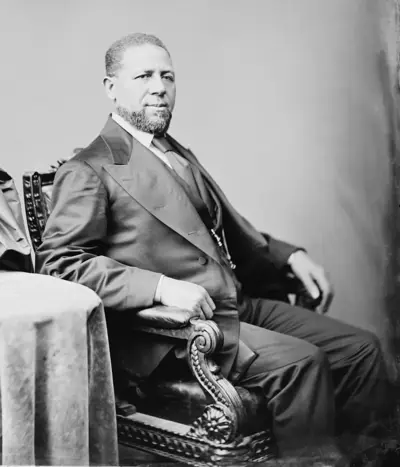
Hiram Rhodes Revels was an American politician, minister in the African Methodist Episcopal Church, and a college administrator. Born free in North Carolina, he later lived and worked in Ohio, where he voted before the Civil War. He became the first African American to serve in the U.S. Congress when he was appointed to the United States Senate as a Republican to represent Mississippi in 1870 and 1871 during the Reconstruction era.
